

Gum Disease and Dental Implants: Why Gums Come First in Albania
Learn why gum disease must be treated before dental implants, how periodontitis affects implant success, and how periodontal treatment is planned in Albania for UK and European patients considering long-term implant treatment.
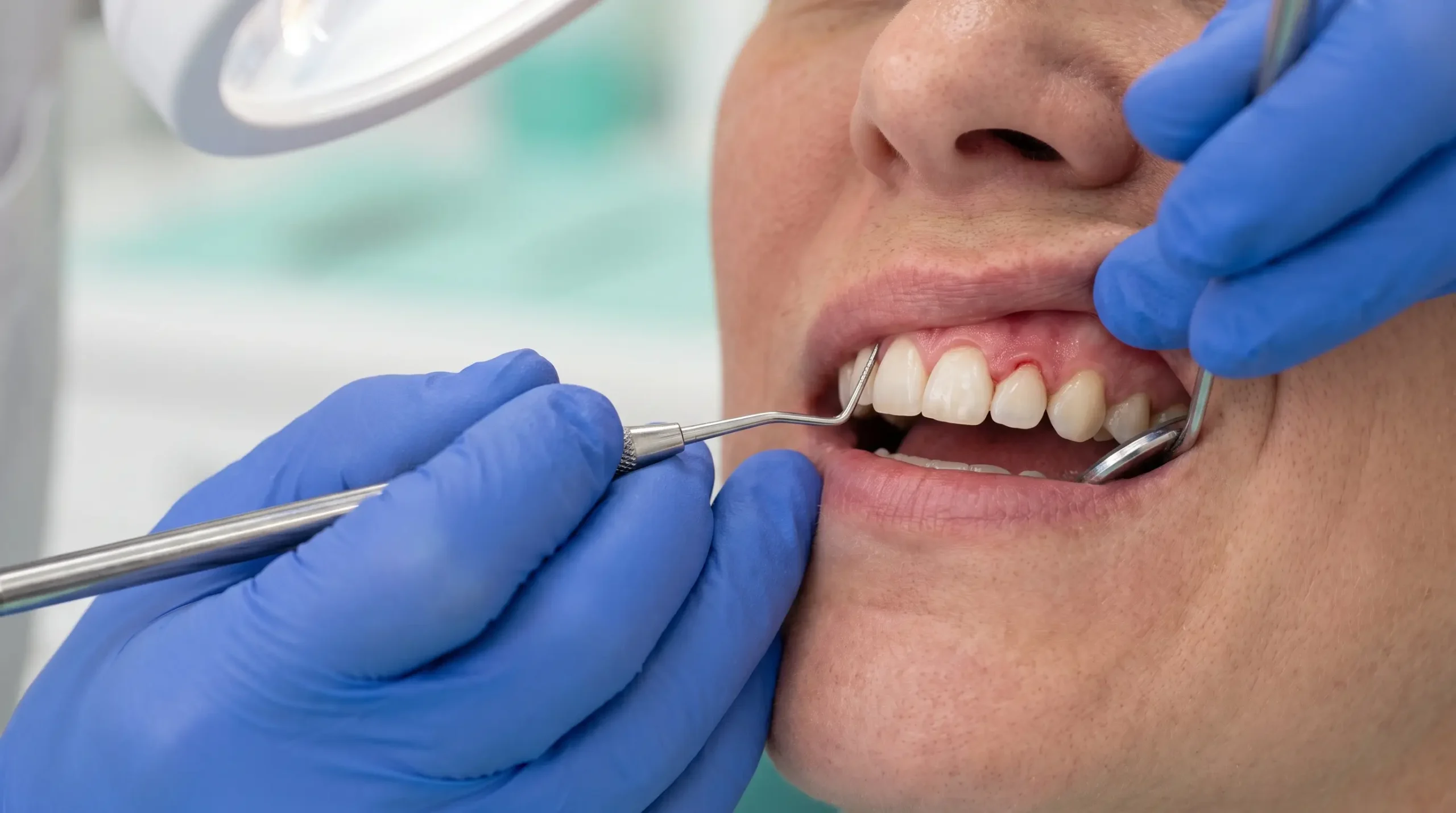
Implants cannot get cavities, which leads a lot of people to assume they are maintenance free. They are not.
The single most common reason an implant is lost years after a technically successful surgery is disease in the gum and bone around it. And the risk of that starts with the gums you already have, before anybody places anything.
This is why we assess gums first, why we sometimes tell patients that implant treatment has to wait, and why an honest quote occasionally includes treatment you were not expecting.
Quick answer: Active gum disease should be treated and stabilised before dental implant placement. Healthy, maintainable gums and good plaque control are important for reducing the risk of inflammation and bone loss around implants.
- Gingivitis: inflammation limited to the gums and reversible with proper care
- Periodontitis: gum disease that involves loss of supporting bone
- Before implants: active periodontal disease may need treatment first
- After implants: long-term cleaning and periodontal maintenance remain essential
What Gum Disease Actually Is
Gum disease has two stages and the distinction between them matters enormously.
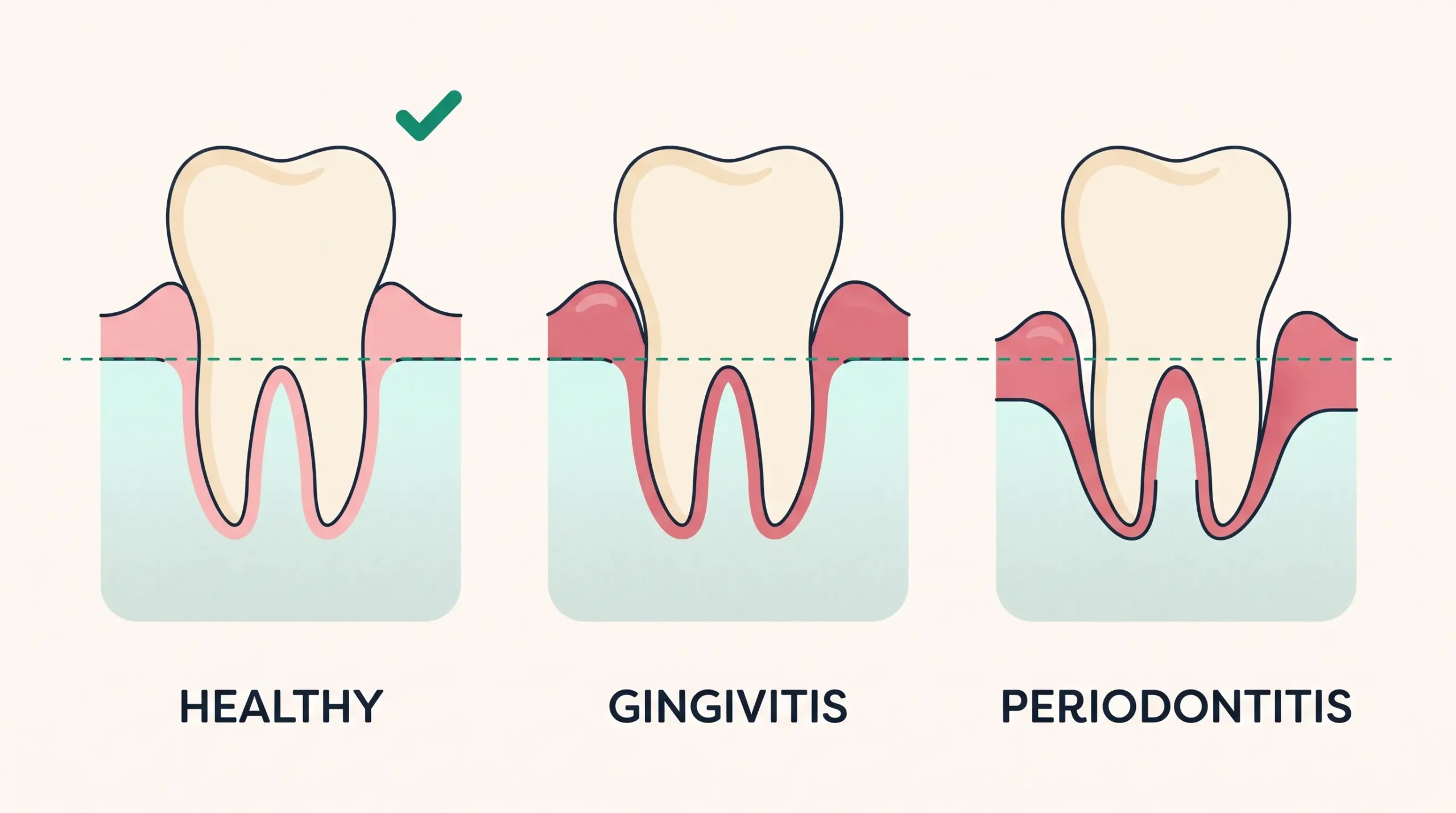
Gingivitis is inflammation of the gum tissue only. Gums are red, slightly swollen, and they bleed when you brush. It is caused by bacterial plaque sitting at the gum margin. It is completely reversible with proper cleaning, professional and at home, and it leaves no permanent damage.
Periodontitis is what happens when gingivitis is left. The inflammation spreads below the gum to the bone that holds your teeth in place, and that bone begins to dissolve. Pockets form between tooth and gum, deeper than the brush can reach, which fill with bacteria and drive the process further. Teeth loosen. Gums recede. Teeth are eventually lost.
Important distinction: Gum inflammation can often be reversed at the gingivitis stage, but bone already lost through periodontitis does not simply grow back on its own.
Periodontitis is common, it is frequently painless until quite late, and it goes undiagnosed constantly. A significant number of patients who come to us wanting an implant learn at their first examination that periodontitis is the reason they lost the tooth in the first place, and that the same disease is quietly working on the teeth either side of the gap.
Why Gum Disease Matters Before Dental Implants
Placing an implant into an actively infected mouth means placing it into exactly the bacteria that destroyed the natural tooth it is replacing.
The equivalent disease around an implant is called peri-implantitis and it behaves in a familiar way: inflammation, then bone loss around the fixture, then loosening, then loss of the implant. It is harder to treat than gum disease around a natural tooth, because the implant surface is textured to encourage bone attachment, and that same texture harbours bacteria beautifully once it is exposed.
The evidence here is not ambiguous. Patients with a history of untreated periodontitis lose implants at a substantially higher rate than patients whose gums were stabilised beforehand.
Which is why we will not place implants into an untreated periodontal case, whatever the patient wants and whatever the travel schedule looks like. It is not a way of adding appointments to a bill. It is the difference between an implant that lasts twenty five years and one that fails in year six, by which point you are in another country.
How Gum Disease Is Treated Before Implant Treatment
Stage One: Assessment
Full periodontal charting, which means measuring the pocket depth at six points around every tooth, plus X-rays to see the bone level. This produces an actual map of the disease rather than an impression of it.
Stage Two: Professional Cleaning and Root Surface Debridement
Removal of plaque and hardened tartar from above and below the gum line, cleaning the root surfaces so that the gum tissue can reattach. This goes considerably deeper than a routine hygiene appointment and is usually done under local anaesthetic across two or more visits.
Stage Three: Reassessment
Six to eight weeks later, pockets are measured again. Most respond well. Some do not, and now we know which.
Stage Four: Surgery Where Needed
Deep pockets that have not responded may need surgical access to clean properly, and in selected cases bone regeneration to rebuild what was lost.
Stage Five: Maintenance
Professional cleaning every three to six months, for life. This part is not optional and it is not an upsell. It is the part that actually holds the result, and skipping it is how people end up back where they started three years later.
All of this sits within our general dentistry service and is planned alongside any implant work rather than separately from it.
Can Gum Treatment Happen on the Same Trip as Implants?
Sometimes.
Mild cases, where pockets are shallow and there is no significant bone loss, can be cleaned and stabilised in the same visit and implants placed as planned.
Moderate to severe cases need the reassessment gap. That means gum treatment on one trip and implants on the next. This is not a delay imposed to sell you extra appointments. It is the interval the tissue needs in order to prove it has responded, and no amount of scheduling pressure changes the biology.
Because implant treatment already requires two trips anyway, this often fits reasonably neatly. Gum treatment and assessment on the first visit, implants on the second, restoration on the third. Our trip planning guide explains how visits are structured.
Warning Signs of Gum Disease Worth Checking Now
If any of these apply to you, have a periodontal assessment before you plan implant or cosmetic treatment.
- Gums that bleed when you brush or floss, even occasionally
- Persistent bad breath, or a persistent bad taste
- Gums that look as though they have receded, or teeth that look longer than they used to in photographs
- Teeth that have shifted position, or gaps that have opened up between front teeth
- Any tooth that feels slightly mobile
- A history of tooth loss that nobody ever fully explained to you
Do not ignore bleeding gums: Bleeding is one of the signs patients dismiss most often. Persistent bleeding when brushing or flossing deserves a periodontal assessment.
Keeping Dental Implants Healthy Afterwards
The regime is not complicated and it is the difference between decades and years.
Brush twice daily including the gum margin, using a soft brush at an angle to the gum rather than scrubbing across it. Use interdental brushes sized to your actual gaps, which a hygienist should size for you rather than you guessing. Use a water flosser, particularly around full arch bridges. Do not smoke. And attend professional cleaning every three to six months.
If you have a fixed full arch bridge such as All-on-4 or All-on-6, the area underneath the bridge is the part that gets neglected and the part that matters most, because you cannot see it and it does not hurt when it goes wrong. We demonstrate exactly how to clean it at the final fitting, and it is worth asking us to show you twice.
Cost of Gum Treatment in Albania
Professional cleaning and periodontal treatment in Tirana costs a fraction of UK or Western European pricing. A combined check up and hygiene package at Andent is available from around €150.
A full periodontal course is quoted after assessment, because the cost depends entirely on how many teeth are affected and how deep the pockets go. Ask for it itemised in your treatment plan, as you should for everything else. Our guide to getting an accurate quote explains what a proper plan contains.
The exact periodontal treatment plan depends on clinical examination, pocket depths, X-rays, bone levels and the number of affected teeth. Implant suitability should be assessed individually.
Frequently Asked Questions About Gum Disease and Dental Implants
Can I get dental implants if I have gum disease?
Not while it is active. Gum disease must be treated and stabilised first, otherwise the same bacteria that damaged your natural teeth will attack the implant.
Does gum disease come back after treatment?
It can, if maintenance cleaning stops. With professional cleaning every three to six months and consistent home care, it stays controlled indefinitely. Periodontitis is managed rather than cured.
Is periodontal treatment painful?
Deep cleaning is carried out under local anaesthetic, so the treatment itself is not painful. Gums are tender for a day or two afterwards and teeth may be sensitive to cold for a short period as the gum tightens.
Will my gums grow back after treatment?
Recession does not reverse on its own, and bone lost to periodontitis does not regenerate without surgical grafting. Treatment stops further loss rather than restoring what has already gone, which is exactly why treating it early matters so much.
How often should I have my teeth professionally cleaned?
Every six months for healthy gums. Every three to four months for anyone with a history of periodontitis or with implants in place.
Does smoking affect gum disease and implants?
Substantially. Smoking reduces blood supply to the gums, masks bleeding so the disease is spotted later, slows healing after surgery, and is one of the strongest predictors of implant failure in the research.
Can I have veneers or crowns if I have gum disease?
Not until it is stabilised. Cosmetic work bonded to teeth in receding gums will look wrong within a couple of years as the gum line moves, and the margins become impossible to clean.
Find Out Where Your Gums Stand Before Implants
Send your panoramic X-ray and we will tell you whether gum treatment needs to come before implants, so that it appears in your plan from the start rather than as a surprise once you have arrived.
Considering dental implants but concerned about your gums? Send Andent your panoramic X-ray for an initial assessment so periodontal treatment, if needed, can be included in your plan before you travel.
Book a Free Assessment
Andent Dental Clinic
Rruga Bardhok Biba, Tirana, Albania
Monday to Saturday, 9:00 to 18:00
Newsletter
Get Dental Tips in Your Inbox
One email per month. Expert guides, patient stories, and exclusive offers — no spam.
Get Started
Free Treatment Plan in 24 Hours
Send us your X-rays or photos. Our specialists will reply with a full, personalised quote — no obligation.
Latest Articles
-
 October 4, 2026
Why Are Dental Implants So Expensive? (And How to Pay 70% Less)
Learn what drives dental implant costs in the UK, why the NHS rarely covers implants, and how treatment in Tirana can reduce the total… Read more
-
 October 4, 2026
How Long Are NHS Dentist Waiting Lists? (And the Fastest Way to Skip the Line)
See how long NHS dentist waiting lists can be, why delays happen, how dental problems can progress, and what alternatives UK patients may consider. Read more
-
 October 3, 2026
How to Find Affordable Dental Care Without Insurance
Explore practical ways to find affordable dental care without insurance, from dental schools and payment plans to lower-cost treatment at Andent Clinic in Tirana. Read more
Ready to Start?
Your New Smile is One
Consultation Away
Send us your X-rays or dental photos and receive a personalised treatment plan with clear pricing within 24 hours — completely free of charge. No obligation. No pressure. Just clarity.