

All on 6: maximum strength for your full arch restoration.
The All on 6 system places six dental implants to anchor a permanent full arch prosthesis. Spreading bite pressure across six anchor points offers wider bone stimulation and exceptional long term support. If you want the most robust, high stability solution for your smile, choose All on 6 at Andent Clinic in Tirana starting from €3,800 per arch.
Six implants for a full arch:
when more support changes everything
Full-arch implant rehabilitation evolved over decades of clinical research aimed at giving completely edentulous patients the closest possible replacement for natural dentition. The earliest full-arch protocols used eight to ten implants per arch, requiring significant bone volume and extensive surgery. The All-on-4 innovation, reduced this to four implants by using angled posterior placements. All-on-6 represents a middle path: fewer implants than the original multi-implant protocols, more than All-on-4, and a configuration that provides genuine clinical advantages in the right patient population.
The key difference between All-on-4 and All-on-6 is not that one is always better. It is that each is optimal for a specific anatomical situation. All-on-4 is designed for patients with posterior bone loss where angled implants allow placement without sinus augmentation. All-on-6 is designed for patients with adequate posterior bone volume where six upright or minimally angled implants can be placed across the full arch.
Why six implants matter clinically
The biomechanical argument for six implants comes from load distribution. A fixed prosthesis supported by six implants distributes each occlusal load event across more titanium-bone contact points. For patients with heavier bite forces, parafunctional habits such as clenching, or a wider arch anatomy, this distribution reduces the stress per implant and may contribute to better long-term outcomes. Additionally, six implants stimulate a wider portion of the alveolar bone, which matters for long-term bone preservation in patients who still have good bone to protect.
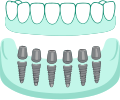
Implants across the full arch
More load distribution points, wider bone stimulation, and structural redundancy that provides additional long-term confidence.
Bone stimulation area
Six implants stimulate bone across a broader portion of the arch than four, helping to preserve bone volume in patients who still have good posterior bone available.
Load distribution per implant
Each occlusal force event is distributed across six implant-bone contact points rather than four. Particularly relevant for heavy biters and parafunctional patients.
Per arch, complete treatment
Six dental implants, same-day provisional, and definitive crown arch. All included, no extras.
Why six implants rather
than four in the right patient
The choice between four and six implants is not about more being better in every case. It is about matching the implant configuration to the patient’s anatomy, occlusal demands, and long-term goals. Here are the specific clinical situations where six dental implants provide a distinct advantage.
Adequate posterior bone volume
When the patient has good bone height and width in the posterior jaw, placing posterior dental implants upright uses that bone rather than bypassing it. The angling in All-on-4 was designed to avoid inadequate posterior bone. When that bone is present, six upright implants make full use of the available anatomy.

Heavy occlusal forces and bruxism
Patients who grind their teeth or have a history of heavy bite force generate greater stress at the implant-prosthesis interface. Distributing this force across six points rather than four reduces the load per implant. Combined with an occlusal guard for bruxism, All-on-6 provides a more durable foundation under these functional demands.
Wider arch anatomy
Some patients have a naturally wide upper or lower arch. A four-implant configuration on a wide arch creates a longer cantilever at the distal end of the prosthesis. Six implants on a wide arch allow better posterior support placement, reducing the cantilever length and the associated mechanical stress on the prosthetic components.
Structural redundancy
In a four-implant supported prosthesis, losing one implant during osseointegration is a more significant event than in a six-implant configuration. Six implants provide a degree of structural redundancy: if one implant requires replacement or shows delayed integration, the remaining five can maintain prosthesis stability during the management period.

Bone preservation priorities
Implants transmit occlusal forces into the surrounding bone, stimulating it and preventing the resorption that occurs when bone has no mechanical load. Six implants stimulate bone across more of the arch than four. For patients who value long-term bone preservation and have good bone to protect, this wider stimulation has clinical value.
Prosthetic design flexibility
Some prosthetic designs for full arches benefit from additional posterior support points. The definitive crown arch, particularly in wider arches, can be designed with shorter cantilever sections when six implants provide posterior support. This allows for a more conservative prosthetic design and better long-term mechanical durability.
All-on-4: optimised for bone-challenged cases
Designed specifically for patients with posterior bone loss. Two angled posterior implants bypass the sinus and inferior nerve, using cortical bone in the anterior jaw. The original innovation that made full-arch rehabilitation accessible without sinus grafting.
All-on-6: optimised for full-bone cases
Six implants distributed across the arch when bone volume allows it. More upright posterior placements use a wider area of available bone. Designed for patients with adequate arch-wide bone who want maximum distribution and stimulation.
Premium Global Implants Only:
the exclusively chosen systems at Andent Clinic
For All-on-6 procedures, Andent Clinic uses top-tier, industry-leading global implants exclusively. The specific system and model is confirmed in the treatment plan before any commitment is made and verified with the patient on surgery day.

These industry-leading systems feature advanced titanium surface technology that accelerates osseointegration. For All-on-6 cases, these advanced implants provide excellent primary stability across a range of bone densities, which is particularly relevant when placing six implants across the full arch.
Developed for maximum reliability, these premium implants feature a tapered design that can be placed with high initial stability even in softer bone, which is highly valuable in All-on-6 cases. Their global distribution network means components for any future maintenance work are available to dentists across Germany, France, Spain, Italy, and every European country.
The ideal All-on-6 patient:
anatomy, bite and long-term goals
All-on-6 is not simply a better version of All-on-4. It is a different configuration suited to a different patient profile. Understanding who benefits most helps patients ask the right questions at their clinical assessment.
Good posterior bone volume throughout the arch
The primary indication for All-on-6 over All-on-4 is adequate bone in the posterior regions. When the 3D CBCT scan shows sufficient bone height and width in the molar and premolar areas to support upright or minimally angled implants, placing six implants uses that bone resource rather than bypassing it through angulation.
Primary indication
Confirmed or suspected heavy bite force
Patients who report jaw clenching, who have worn their natural or prosthetic teeth significantly, or who are known bruxists. Six implants share the occlusal load at each bite event. Combined with a protective occlusal guard, All-on-6 provides the most durable foundation for patients with demanding functional requirements.
Functional indication
Wider arch dimensions
Some patients have naturally wider arches. The cantilever length of a four-implant supported prosthesis on a wide arch is greater than on a narrow arch. Six implants allow posterior support placement that shortens this cantilever and improves the mechanical longevity of the crown prosthesis over time.
Architectural indication
Priority on maximum long-term stability
Some patients, particularly those who have delayed treatment for years and are now committing to a definitive restoration, explicitly want the most robust foundation available. When anatomy allows it, six implants provide this with a level of structural redundancy that four implants cannot. This is a legitimate patient preference that influences the clinical recommendation.
Patient preference indication
Controlled systemic conditions with good bone density
Some patients with conditions such as controlled type 2 diabetes or managed osteoporosis have adequate bone density but have reduced healing reserve. Six implants in good bone provide more osseointegration contact area, which can compensate for the slightly impaired healing response characteristic of these conditions when well-controlled.
Medical nuanceThe All-on-6 surgical
process step by step
The All-on-6 procedure follows the same logical sequence as any full-arch implant case: thorough planning, precise surgery, immediate provisional, and monitored recovery. The difference from All-on-4 is in the planning detail and the slightly longer surgery time required to place two additional implants.
Panoramic X-ray review and personalised plan
Send your panoramic X-ray to the Andent coordination team. Dr. Çurmaku assesses the bone anatomy, gives an initial recommendation for All-on-4 or All-on-6, and returns a personalised plan with exact pricing within 24 hours. No consultation fee.
Free · 24-hour response3D CBCT scan and digital surgical planning
Full 3D cone beam scan taken on arrival. Dr. Çurmaku reviews the scan with the patient, confirms the six implant sites, and designs the surgical guide digitally. Any change from the pre-travel plan is explained before any procedure begins. This is the clinical foundation that makes the surgery predictable.
Confirms All-on-6 is right for youExtractions if needed
Any failing teeth remaining in the arch are extracted in the same surgical session. The extraction sites are managed to preserve bone where possible. Immediate implant placement into fresh extraction sockets is considered where bone conditions allow.
Same session as implantsSix implants placed and torque verified
Six dental implants are placed at the positions determined by the 3D plan. Placement torque is measured and recorded for each implant. PIC DENTAL photogrammetry captures the precise implant positions before any prosthetic component is attached. Implants achieving sufficient stability receive the provisional abutments immediately.
Approximately 2 to 3 hoursFixed provisional prosthesis attached
The provisional reinforced acrylic bridge, fabricated from pre-surgical impressions, is attached to all six implants before the patient leaves. Bite is adjusted. The patient leaves with fixed teeth on the day of surgery. Eating soft foods begins the same evening.
Fixed teeth before you leaveMonitored recovery, departure check, return home
Recovery at the partner stay with daily clinical team availability. Swelling typically peaks at 72 hours and resolves by day five to six. Post-operative check before departure. Full clinical documentation and written guarantee provided. Return home with fixed teeth.
Departure with documentationWhat you leave with
and what you return for
All-on-6 treatment involves two prosthetic stages. Both are included in the quoted price. Understanding what each provides and why the two-stage approach exists is the best preparation for a smooth treatment experience.
The provisional prosthesis
A reinforced PMMA acrylic bridge that is pre-fabricated from your pre-surgical impressions and attached to the six implants on the day of surgery. It is a fully functional prosthesis from the moment it is placed: you can eat soft foods, speak normally, and smile with confidence before you leave the operating room.
The provisional is also a clinical instrument. Over the following months, the way it functions in your bite, the adaptation of your facial muscles and soft tissues, and any adjustments made to it inform the final design of the definitive crown arch. The definitive prosthesis benefits from the information the provisional provides during the healing phase.
The definitive crown arch
Milled from high-strength monolithic crown ceramic in Andent Clinic’s in-house CAD/CAM laboratory after osseointegration is confirmed on a follow-up 3D scan. crown is the material of choice for full-arch definitive prostheses because of its combination of strength (900 to 1,200 MPa), biocompatibility, aesthetics, and resistance to the heavy loads that full-arch prostheses must manage.
The definitive arch is screwed permanently to the premium abutments. It can only be removed by the clinician using the prescribed torque specifications. The screw-access channels allow future retrieval for maintenance if ever needed, without damaging the arch. It looks and functions like natural teeth in every respect.
Send panoramic X-ray. Receive plan from Dr. Çurmaku within 24 hours. Confirm dates, book flights, coordinate patient stay.
Arrive Tirana. Airport transfer included. 3D CBCT scan reviewed with Dr. Çurmaku. All six implant sites planned and confirmed.
Extractions if needed. Six implants placed. Primary stability verified. Provisional arch fitted within 24 hours.
Daily clinical team availability. Swelling peaks at 72 hours. Post-operative check before departure.
Provisional in full function. Gradual diet expansion. Check-up with home dentist using Andent documentation.
2 to 3 days in Tirana. Osseointegration confirmed on 3D scan. Definitive crown arch fitted. Treatment complete.
What All-on-6 costs in your country
compared to Andent Clinic
Select your country to see the specific price comparison, typical savings calculation, and flight connections to Tirana from major cities.
🇩🇪 All-on-6 für Patienten aus Deutschland
In Deutschland kostet ein vollständiges All-on-6 an einer führenden Implantologiepraxis in Berlin, München, Hamburg oder Frankfurt zwischen €16,000 und €26,000 pro Kiefer. Die gleiche Behandlung mit sechs Premium-Implantaten in der Andent Klinik in Tirana kostet €3,800 pro Kiefer.
German statutory health insurance covers only a percentage of basic implant costs through a fixed subsidy system (Festzuschuss). Supplementary dental insurance may contribute additional reimbursement, but All-on-6 full arch treatment remains largely patient-funded in Germany. The Andent clinical documentation meets German documentation standards for insurance reimbursement applications, including precise implant brand, model, batch number, and surgical data.
German patients represent one of the largest international patient groups at Andent Clinic. The coordination team includes German-speaking staff throughout the entire process from initial enquiry to post-treatment follow-up. All clinical documentation can be provided in German on request.
- ✈️ Frankfurt (FRA) to Tirana: 2h 20min, daily (Lufthansa, Wizz Air) from €60 return
- ✈️ Munich (MUC) to Tirana: 2h 15min, 4 to 5x weekly from €65 return
- ✈️ Berlin (BER) to Tirana: 2h 30min, 3x weekly from €70 return
- ✈️ Hamburg to Tirana: via Frankfurt or Munich from €80 return
🇫🇷 All-on-6 pour les patients de France
En France, une réhabilitation All-on-6 complète dans un centre d’implantologie de premier plan à Paris, Lyon, Bordeaux ou Marseille coûte entre €14,000 et €22,000 par arcade. La même intervention avec six implants à la Clinique Andent de Tirana coûte €3,800 par arcade.
In France, dental implants are partially reimbursed by social security under the 2021 dental reform (RAC0 system) for some single-tooth implants, but full-arch rehabilitation remains outside the reimbursed scope and is patient-funded. Supplementary mutuelle insurance may contribute a partial reimbursement, but the patient contribution for All-on-6 in France remains very high regardless of insurance coverage.
The French-speaking coordinator at Andent Clinic manages all communication from initial contact through to post-treatment follow-up in French. Clinical documentation is provided in French on request.
- ✈️ Paris CDG to Tirana: 2h 30min, 4x weekly (Air France, Wizz Air) from €65 return
- ✈️ Paris Orly to Tirana: 2h 25min, regular connections from €60 return
- ✈️ Lyon or Nice: connections available via Paris or Rome
🇪🇸 All-on-6 para pacientes de España
En España, el All-on-6 en una clínica de implantología de primer nivel en Madrid, Barcelona, Valencia o Sevilla cuesta entre €13,000 y €20,000 por arcada. El mismo tratamiento con seis implantes en la Clínica Andent de Tirana cuesta €3,800 por arcada.
La sanidad pública española no cubre los implantes dentales. Los seguros dentales privados pueden reembolsar parcialmente algunos implantes unitarios, pero la rehabilitación completa All-on-6 queda fuera del reembolso estándar. El coordinador hispanohablante de la Clínica Andent gestiona toda la comunicación en español.
Desde España, los vuelos a Tirana son frecuentes y accesibles. La distancia geográfica hace que el viaje sea muy manejable para los pacientes españoles, y el ahorro en el tratamiento compensa ampliamente el coste del desplazamiento.
- ✈️ Barcelona (BCN) to Tirana: 2h 45min, opciones regulares desde €70 ida y vuelta
- ✈️ Madrid (MAD) to Tirana: 3h 10min, Wizz Air y conexiones desde €75 ida y vuelta
- ✈️ Valencia, Málaga: conexiones via Roma, Viena o Madrid
🇮🇹 All-on-6 per i pazienti dall’Italia
In Italia, il trattamento All-on-6 completo in una clinica di implantologia di alto livello a Roma, Milano, Firenze o Napoli costa tra €14,000 e €22,000 per arcata. Lo stesso trattamento con sei impianti alla Clinica Andent di Tirana costa €3,800 per arcata.
For Italian patients, the geographic proximity of Tirana is a particular advantage for All-on-6 treatment which involves two visits. The first visit (surgery and provisional) and the second visit (definitive arch) can both be managed with very short flights. Rome to Tirana takes 1 hour 45 minutes. Milan takes under 2 hours. The combined flight cost for both visits rarely exceeds €200.
Il coordinatore italiano alla Clinica Andent gestisce tutta la comunicazione in italiano, dalla valutazione iniziale alla documentazione clinica finale. Le relazioni cliniche vengono fornite in italiano su richiesta.
- ✈️ Roma FCO to Tirana: 1h 45min, giornaliero (ITA, Wizz Air) da €55 andata e ritorno
- ✈️ Milano MXP to Tirana: 1h 50min, giornaliero da €55 andata e ritorno
- ✈️ Napoli, Bari: connessioni via Roma, circa 3h in totale
🇨🇭 All-on-6 for patients from Switzerland
Switzerland has the highest dental fees in Europe. All-on-6 at a leading global oral surgery centre costs between CHF 20,000 and CHF 32,000 per arch. At Andent Clinic in Tirana, the same six-implant full-arch treatment costs €3,800 per arch. International patients save more per case in absolute terms than patients from any other European country, typically CHF 16,000 to CHF 27,000 per arch.
Global dental insurance rarely covers the full cost of implant-based full arch rehabilitation. The patient contribution for All-on-6 in Switzerland, even with supplementary dental coverage, typically represents the largest private medical expense most patients face. The Andent Clinic documentation fully supports insurance reimbursement applications.
The coordination team covers German, French, and Italian, serving all three national language regions without any communication barrier.
- ✈️ Zurich (ZRH) to Tirana: 2h 10min, 4 to 5x weekly (Swiss, Wizz Air) from CHF 80 return
- ✈️ Geneva (GVA) to Tirana: connections via Zurich, ~4 hours total
- ✈️ Basel (BSL) to Tirana: connections via Zurich or Frankfurt
🇦🇱 All-on-6 për pacientët lokalë dhe diasporën shqiptare
Andent Clinic serves Albanian patients directly at the clinic in central Tirana, as well as the Albanian diaspora living across Germany, Italy, Switzerland, Greece, and beyond. For Albanian patients, All-on-6 provides a world-class full-arch restoration using Dental implants at Albanian market prices.
Patients from Kosovo, North Macedonia, and the broader Western Balkans also regularly travel to Andent Clinic for full-arch treatments. Tirana is accessible by road from most regional capitals and by direct flight from a growing number of European cities. The clinic’s full clinical team is Albanian-speaking and the standard of care is identical to that provided to international patients.
The clinic’s proximity to the main international airport and the patient stay coordination that even Albanian patients from outside Tirana can organise their treatment as a short stay without needing to commute to multiple appointments over weeks.
- 🚗 Pristina, Kosovo: approximately 3 hours by road
- 🚗 Skopje, North Macedonia: approximately 3.5 hours by road
- ✈️ Athens to Tirana: daily direct, 1 hour 10 minutes
Recovering from All-on-6:
what the days after surgery look like
All-on-6 involves placing six implants in one surgical session. The inflammatory response to this is slightly greater than for a two or three-implant case, but it follows a predictable pattern that is well managed with the post-operative protocol provided at Andent Clinic. Knowing what to expect prevents unnecessary anxiety when swelling peaks at 72 hours.
The most important thing to understand about recovery from All-on-6 is that the fixed provisional prosthesis you leave with is fully functional. You do not experience the toothless period that many patients fear. You leave the clinic on surgery day with a complete set of teeth in the arch that was treated.
What to eat during recovery
The dietary protocol after All-on-6 is a graduated progression. Surgery day and days one to three: liquids and soft foods only, nothing requiring biting force. Days four to fourteen: full soft foods, pasta, fish, eggs, soup, yogurt, cooked vegetables. Weeks three to eight: normal soft diet. After osseointegration and final arch fitting: normal full diet including foods that were impossible with dentures.
What to avoid
- Smoking during the osseointegration period significantly impairs healing and increases the risk of peri-implantitis. If you smoke, cessation is strongly advised.
- Alcohol in the first 72 hours post-surgery can interfere with prescribed medications and impair clotting.
- Very hard or chewy foods during the provisional phase can stress the implants before osseointegration is complete.
- Skipping the prescribed antibiotics or anti-inflammatory course. These are not optional additions.
Surgery complete, provisional teeth in place
Leave the clinic with fixed teeth. Some numbness from anaesthesia. Begin antibiotic and anti-inflammatory course. Soft foods and liquids only.
Fixed provisional in placePeak swelling
Facial and jaw swelling at its most pronounced. Normal and expected. Cold compresses reduce discomfort. This is the most uncomfortable point of the recovery. The clinical team is reachable at any hour.
Expected · ManageableVisible improvement
Swelling reduces noticeably from day four. Energy returns. Soft food diet expands. Many patients can explore Tirana gently on day five.
Improving dailyPre-departure check
Post-operative appointment at the clinic. All six implant sites inspected. Provisional stability and bite confirmed. Any adjustments made. Cleared for flight.
Pre-departure appointmentProgressive normalisation at home
Swelling fully resolved. Provisional in normal function. Diet expanding gradually. Follow-up with home dentist using Andent documentation for X-ray review at 6 to 8 weeks.
Osseointegration progressingReturn for definitive crown arch
3D scan confirms full osseointegration of all six implants. Provisional removed. Definitive crown arch fitted. Treatment complete. Final result in place for 15 to 20+ years.
Treatment completeAll-on-6 patients from
across Europe at Andent Clinic
These accounts come from patients who specifically chose All-on-6 over All-on-4, and their reasons vary. What they share is a clinical assessment that recommended six implants and a result that confirmed the decision.
“Mein Implantologe in Stuttgart hatte mir All-on-4 empfohlen, aber nach dem 3D-Scan sagte Dr. Çurmaku, dass mein Knochenvolumen für sechs Implantate ausreiche. Die Entscheidung für All-on-6 war definitiv die richtige. Mein Zahnarzt daheim war beeindruckt vom Befundbericht.”
“J’avais demandé l’option avec le plus grand nombre d’implants possible. Le scanner 3D à Tirana a confirmé que j’avais la densité osseuse pour six. La coordinatrice parlait français parfaitement. Le résultat final après la deuxième visite est exactement ce que j’espérais.”
“Sono bruxista e il mio dentista in Italia aveva consigliato più impianti per una migliore distribuzione del carico. All-on-6 con era la scelta logica. Da Milano il volo dura meno di due ore. Il coordinatore parlava italiano fin dal primo messaggio.”
Miriam had been a denture wearer for nine years following periodontal disease that had progressively destroyed the supporting bone around her natural teeth. A Spanish oral surgeon in Valencia had quoted her €19,500 per arch for All-on-6, a total of €39,000 for the double arch. Before committing, she researched alternatives online and found Andent Clinic through a Spanish dental tourism forum where three separate users had recommended it.
“Lo que más me convenció fue que la coordinadora me respondió en español desde el primer mensaje, que la doctora revisó mi radiografía panorámica personalmente y me explicó exactamente por qué recomendaba All-on-6 en mi caso específico. No era una plantilla genérica. Era un plan médico real basado en mis datos.”
The 3D scan on arrival confirmed what the panoramic X-ray had suggested: Miriam had better posterior bone volume than average for a patient who had experienced the degree of bone loss associated with her periodontal history. The bone had remineralised to a level that supported six upright-placed dental implants in both arches without grafting in either jaw.
Surgery day involved the placement of twelve dental implants in total, six per arch, in a single session. The total operating time was approximately five hours. “The anaesthesia was so effective that I was more surprised by how little I felt than by anything else. The team explained every step before doing it. I left with fixed teeth in both arches that evening.”
Both provisional arches were in place for five months. The definitive crown arches were fitted on Miriam’s second visit to Tirana, which she combined with a four-day trip to explore the Albanian Riviera. Total cost for the entire treatment including both visits, flights, accommodation, and meals: approximately €9,600. The Valencia quote for the treatment alone had been €39,000.
How the international
All-on-6 process works
Organising a full-arch implant treatment from Germany, France, Spain, Italy, or any other country involves more planning than a single crown or bridge. Andent Clinic has managed this process for international patients since 2007 and has made it as straightforward as possible. Here is the exact sequence.
Send your panoramic X-ray for a free assessment
WhatsApp or email your panoramic X-ray. Dr. Çurmaku assesses bone volume and gives her initial All-on-4 or All-on-6 recommendation with exact pricing within 24 hours. Free, no commitment.
Confirm dates and receive your full trip plan
Once the plan is agreed, your coordinator confirms your treatment dates, books the patient stay coordination, organises the airport transfer, and sends you a day-by-day schedule before you buy flights.
Travel to Tirana
A driver with your name meets you at arrivals. Free transfer to the clinic. The coordinator is available throughout your stay by phone and WhatsApp for any non-clinical questions.
Day 1: 3D scan confirms the All-on-6 plan
The CBCT scan confirms all six implant positions. Dr. Çurmaku reviews it with you in person. Any modifications from the pre-travel plan are discussed before any procedure begins.
Day 2: surgery and provisional fitting
All-on-6 surgery performed by Dr. Çurmaku. Fixed provisional prosthesis placed before you leave the operating room. Recovery monitored at your private accommodation.
Departure with full documentation
Clinical report in your language. Implant brand, model, batch number, torque values. Written guarantee. Free return airport transfer. WhatsApp access to the clinical team indefinitely.
Why All-on-6 in Albania is the right choice for patients who qualify
Full-arch implant rehabilitation is one of the most significant elective medical decisions a person can make. The anatomy that determines whether All-on-4 or All-on-6 is appropriate is not something that can be guessed from a photograph or estimated from a dental history. It requires a 3D CBCT scan and a clinician with the experience to read that data correctly and apply it to a specific patient’s treatment goals.
What Andent Clinic provides for All-on-6 patients is not simply six implants at a lower price than Western Europe charges. It is a complete clinical framework: proper pre-surgical imaging, a manufacturer-certified implantologist, documented premium dental implant brands, an in-house laboratory for the provisional and definitive prosthetics, and a post-treatment support structure that keeps the patient connected to the clinical team indefinitely after they return home.
The honest difference between All-on-6 and All-on-4 for the right patient
The clinical argument for All-on-6 in patients with adequate bone is straightforward. Six implants distribute each occlusal load event across a greater number of implant-bone contact points. They stimulate bone across a wider portion of the arch, which matters for long-term bone preservation. They provide a degree of structural redundancy that four implants cannot. And they allow the posterior prosthetic design to rest on support points that are closer to where the bite force is generated, reducing cantilever mechanics.
None of these advantages exist in isolation. They matter most for patients who have good posterior bone to use, who generate significant bite forces, or who have wide arch dimensions. For patients without these characteristics, All-on-4 in Albania remains the more appropriate choice. The Andent Clinic recommendation is always anatomy-first, not revenue-first.
What patients ask before choosing
All-on-6 in Albania
All-on-6 at Andent Clinic Tirana costs €3,800 to €4,200 per arch, depending on the implant brand selected. This covers six dental implants, the immediate provisional prosthesis placed on surgery day, and the definitive dental crown fitted on the second visit 4 to 6 months later. In Germany the equivalent costs €16,000 to €26,000. In France €14,000 to €22,000. In Spain €13,000 to €20,000. In Italy €14,000 to €22,000. The saving is typically 70 to 82 per cent before travel costs.
All-on-4 uses four implants with angled posterior placements specifically designed for patients with moderate to significant posterior bone loss, allowing implant placement without sinus augmentation. All-on-6 uses six implants, typically placed more upright, and requires adequate bone volume across the arch. All-on-6 distributes bite forces across more implant points, stimulates a wider bone area, and provides greater structural redundancy. It is the preferred option for patients with good posterior bone who prioritise maximum stability and bone preservation.
Not categorically. All-on-6 provides clinical advantages in patients with adequate posterior bone: better force distribution, wider bone stimulation, and more structural redundancy. All-on-4 was designed to solve the problem of posterior bone deficiency that would otherwise require sinus grafting. In a patient with good arch-wide bone, All-on-6 is the better clinical choice. In a patient with posterior bone loss, All-on-4 is the procedure that All-on-6 cannot replace without bone grafting. The 3D CBCT scan determines which is appropriate for your anatomy.
Andent Clinic uses industry-leading premium European implants for All-on-6. The specific brand and model is confirmed in the treatment plan before travel and verified with the patient on surgery day. These are the same premium systems used by leading oral surgery practices in Germany, France, Spain, Italy, and across Europe. All components are original manufacturer products, ensuring global compatibility for any future maintenance at home.
The first visit takes 7 to 9 days. Day 1 is the 3D scan and planning. Day 2 is surgery with immediate provisional fitting. Days 3 to 8 are monitored recovery with a pre-departure check. A second visit of 2 to 3 days is required 4 to 6 months later for the definitive crown arch. The osseointegration period is slightly longer than for All-on-4 because six implant-bone interfaces integrate in the same period.
Yes. Andent Clinic treats patients from all these countries regularly. The coordination team speaks German, French, Spanish, and Italian in addition to English and Albanian. Direct flights connect major cities in all four countries to Tirana. Clinical documentation is provided in the patient’s language. The premium European implants used are the same industry-leading systems available in all European countries, ensuring complete care continuity when the patient returns home. You can learn more on the dental tourism in Albania page.
Yes. The Andent Clinic discharge documentation provides the exact implant brand, model, diameter, length, placement torque, and abutment reference for all six implants placed. Our chosen premium European systems are globally recognised, with components stocked by implantologists across Germany, France, Spain, Italy, and every major European country. Your home implantologist can work with these implants without needing to contact Albania.
Not sure if All-on-6 is right for you?
Compare full-arch implant options, explore dental implant treatment in Albania, or view real patient smile results before requesting your personalised plan.
Get your All-on-6 quote today
Send your panoramic X-ray. Dr. Çurmaku assesses whether All-on-6 or All-on-4 is right for your anatomy and sends a personalised plan with exact pricing in 24 hours.
Mon to Sat · 9:00 to 18:00 CET
WhatsApp 7 days
🇩🇪 🇫🇷 🇪🇸 🇮🇹 🇬🇧 spoken
Other treatments to combine
in the same trip


Real patient experiences
What patients say about
their treatments at Andent
All-on-6 in Albania.
From €3,800. Dental Implants.
Send your panoramic X-ray and Dr. Çurmaku will tell you honestly whether All-on-6 is the right procedure for your anatomy. Free, no obligation, in your language, within 24 hours.