

Replace a missing tooth without surgery. Fixed. Permanent. Fast.
Dental bridges at Andent Clinic in Tirana replace missing teeth with fixed, natural-looking restorations designed for comfort, strength, and long-term bite support. A bridge fills the gap left by a missing tooth by anchoring a false tooth between two prepared natural teeth, without implant surgery, bone grafting, or a long healing wait. Our in-house dental laboratory mills your bridge in 48 hours, so you leave Tirana with the result permanently in place.
Three teeth treated.
One seamless result.
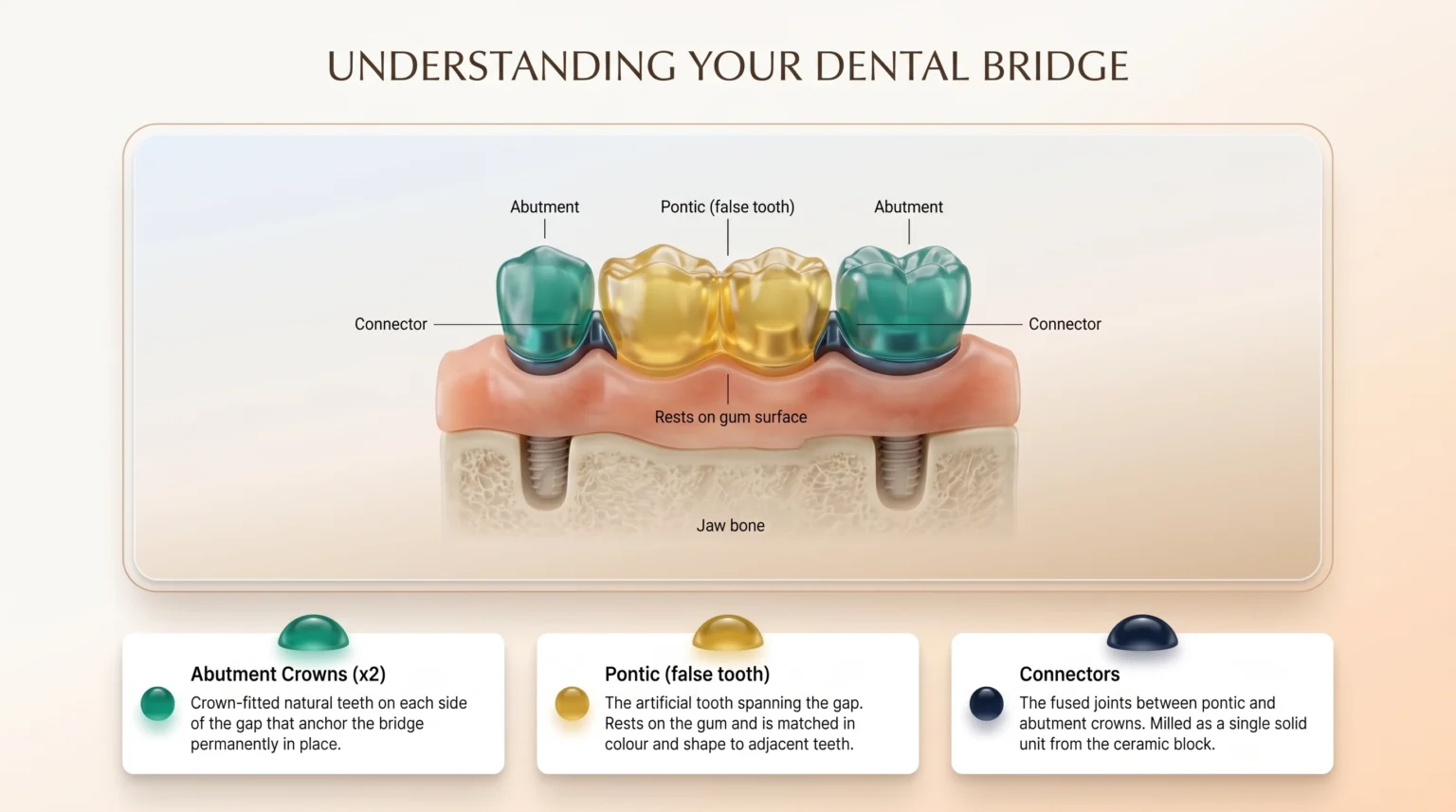
A dental bridge is a fixed prosthetic device that spans the gap left by a missing tooth. Understanding how it is built helps explain both its strengths and the clinical situations where it works best.
Every bridge has three structural components. The two outer units are called abutments. These are the natural teeth on either side of the gap, which are prepared by removing a controlled amount of enamel and dentine to receive crowns. Those crowns anchor the bridge in place. The middle unit is called the pontic. This is the artificial tooth that sits over the gap and recreates the missing tooth in every visible way — colour, size, form, and bite function.
The key distinction between a bridge and a removable partial denture is permanence. A bridge is cemented in place and cannot be taken out. It functions like your natural teeth. You do not remove it to clean it. You eat with it, speak with it, and smile with it exactly as you would with natural teeth. No clasps, no adhesive, no overnight soaking.
What the bridge cannot do is replace the missing tooth root below the gum line. Because the pontic rests on the gum surface without anchoring into the bone, the bone underneath gradually reduces in volume over time through a process called resorption. This happens slowly and does not affect how the bridge functions or looks in the short to medium term, but it is a clinically meaningful difference from an implant for patients planning for twenty or more years.

Bridge or implant:
when each one is the right answer
This is the question every patient with a missing tooth faces. There is no universally correct answer. The right choice depends on the clinical condition of the adjacent teeth, not on cost alone or on a general preference for one treatment over the other.
When the bridge is clinically the stronger choice
- The adjacent teeth already need crowns for independent clinical reasons — caries, cracks, or old restorations needing replacement. The bridge treats all three teeth in one procedure.
- Bone volume at the missing tooth site is too reduced for an implant without an extensive graft. A bridge does not require bone at the pontic site at all.
- The patient prefers to avoid surgery and anaesthesia beyond the standard preparation appointment.
- Speed is a priority — the bridge process in Tirana takes 4 to 5 days with results on the same trip, the same as the crown process.
- Budget is a meaningful factor — a 3-unit bridge from €500 treats three teeth simultaneously, compared with a single implant at €400 to €800 that treats only one.
- Adjacent teeth are prepared irreversibly even when they would otherwise need no treatment
- Bone loss at the pontic site occurs gradually over years without active stimulation
- Cleaning beneath the pontic requires superfloss or a water flosser — standard brushing is not sufficient
When the implant is the better long-term investment
- The adjacent teeth are completely healthy with no existing restorations, caries, or clinical need for crowns. Leaving them untouched is the conservative and correct choice.
- Preserving jaw bone at the missing tooth site is a priority — the implant root stimulates the bone and prevents resorption.
- The patient is planning for maximum longevity. Implants placed with Straumann and an other brands implants components have clinical documentation demonstrating exceptionally high survival rates over decades of clinical research.
- Long-term maintenance simplicity matters — the implant crown is cleaned exactly like a natural tooth with standard brushing and flossing.
- Requires surgical placement under local anaesthesia
- Osseointegration period of 6 to 12 weeks before the definitive crown is placed
- Higher initial cost for a single tooth replacement compared with a 3-unit bridge
Choose the bridge when…
The teeth on either side of the gap already need crowns. Or bone volume at the gap is insufficient for an implant. Or you need a result within a single trip without any surgical recovery period. In these situations, the bridge is not a compromise — it is the correct clinical answer.
Choose the implant when…
Both adjacent teeth are healthy and untouched. Or you are prioritising the longest possible lifespan and bone preservation. Or you want the simplest long-term maintenance. In these situations, the bridge sacrifices healthy tooth structure to achieve a result the implant provides without that cost.
Four types of dental bridge.
One right solution per case.
The type of bridge used depends on how many teeth are missing, where in the mouth the gap is located, and the condition of the available supporting teeth.
Traditional 3-Unit Bridge
The most common bridge design worldwide. One pontic (false tooth) suspended between two abutment crowns. Replaces a single missing tooth. Both abutment teeth are prepared and receive full crowns as part of the bridge structure. The result is a solid three-piece unit cemented permanently in place. Ideal when one tooth is missing and both neighbours are present and healthy enough to serve as abutments.
Most common · Single missing toothExtended Bridge (4 to 6 Units)
When two or three adjacent teeth are missing, the bridge spans a wider gap using multiple pontics supported by abutment teeth at each end. The structural engineering of a longer bridge places greater load on the abutment teeth, which must have sufficient root support and bone levels to carry the additional load safely. Bone levels and abutment root health are assessed from X-rays before the treatment plan is confirmed.
Two or three consecutive missing teethCantilever Bridge
A cantilever bridge is anchored on only one side rather than two. It is used when there is only one adjacent tooth available — typically at the end of the dental arch. The biomechanics of a cantilever design place higher stress on the single abutment tooth, so this option is selected carefully and primarily for teeth that do not bear heavy bite forces. It is more commonly indicated in the front of the mouth than the back.
Single abutment available · Front teethMaryland (Resin-Bonded) Bridge
A Maryland bridge uses metal or crown wings bonded to the backs of the adjacent teeth, with minimal or no preparation of the tooth surfaces. It is the most conservative option when the adjacent teeth are completely healthy and the patient strongly wants to avoid preparation. The trade-off is lower retentive strength compared with a traditional bridge, making it most suitable for front teeth where bite forces are lower. It is not recommended for molars.
Minimal tooth preparation · Front teeth onlyWhich ceramic material:
is right for your bridge?
Bridge fabrication uses the same ceramic materials as individual crowns, but the clinical selection follows slightly different logic because a bridge spans a gap and carries higher structural loads than a single-tooth crown. Here is how the three options perform in a bridge context.
Monolithic Crown
| Flexural strength | 900 to 1,200 MPa |
| Bridge span suitability | Ideal up to 6 units |
| Metal-free | Yes |
| Estimated lifespan | 12 to 15 years average |
| UK equivalent (3-unit) | £2,200 to £3,500 |
The Monolithic Crown is the preferred choice for bridges due to its high flexural strength, allowing it to handle bending forces under bite load. While a crown mainly resists vertical pressure, a bridge must also withstand lateral stress as the pontic receives force without root support. The Crown’s strength makes it ideal for these demands. At Andent Clinic, crown blocks are sourced from trusted German and Swiss manufacturers for consistent quality and durability.
E.max Lithium Disilicate
| Flexural strength | 350 to 450 MPa |
| Bridge span suitability | Up to 4 units in anterior zone |
| Metal-free | Yes |
| Estimated lifespan | 10 to 14 years |
| UK equivalent (3-unit) | £2,600 to £4,200 |
E.max is widely known for its exceptional translucency, making it ideal for anterior bridges where aesthetics are critical. In cases such as a 3-unit bridge replacing a single front tooth, it allows the pontic to blend naturally with surrounding teeth. This creates a seamless and lifelike appearance when the patient smiles. However, it is not recommended for molar regions or patients with bruxism due to lower resistance under heavy load.
Porcelain Fused to Metal
| Fracture resistance | Very high (metal substructure) |
| Bridge span suitability | Reliable for all spans |
| Metal-free | No |
| Estimated lifespan | 10 to 15 years |
| UK equivalent (3-unit) | £1,700 to £2,900 |
PFM bridges combine a strong metal substructure with a porcelain outer layer, offering reliable fracture resistance that has made them a trusted option for decades. They are suitable for longer bridges, especially when replacing multiple missing teeth where structural support is essential. While there may be a slight aesthetic compromise over time, this is typically not visible in posterior areas and remains clinically acceptable in most cases.
Prepared Day 1.
Cemented Day 5.
Every bridge at Andent Clinic follows a 4 to 5 day process from first assessment to permanent cementation. The timeline is possible because the laboratory is inside the clinic building, meaning fabrication starts the same afternoon as your preparation appointment.
X-ray and free quote
Send a panoramic X-ray by email or WhatsApp. Receive a personalised bridge plan with material recommendation, number of units, and exact price within 24 hours.
Assessment and shade matching
Clinical exam, X-ray confirmation of abutment tooth health, shade selection with the lab technician present. Preparation appointment scheduled for Day 2 morning.
Abutment preparation and scan
Both abutment teeth prepared under local anaesthesia. Digital 3D intraoral scan taken instead of messy traditional impressions. Provisional bridge fitted the same day to protect prepared teeth and maintain aesthetics.
In-house bridge milling
The laboratory mills the complete bridge unit overnight using CAD/CAM technology. Connector geometry, pontic shape and shade are refined in direct conversation between clinician and technician. You are free to explore Tirana.
Fit, verify and cement permanently
Bridge seated and checked for fit, contact points, emergence profile and bite. Permanently cemented. Superfloss and water flosser technique demonstrated. Clinical report in English provided for your home dentist.
The cleaning technique
that determines longevity
This is the section most clinics skip when fitting bridges, and it is the information that matters most to how long the restoration lasts. Cleaning a dental bridge is not the same as cleaning natural teeth. Standard brushing alone is not sufficient, and patients who do not understand why find out the hard way when secondary decay develops on the abutment teeth under the bridge margin a few years after cementation.
The critical area to clean is the gap between the underside of the pontic and the gum surface beneath it. This gap traps food debris and plaque. If plaque accumulates in this area daily over months and years, it leads to gum inflammation around the abutment teeth and eventually to decay at the crown margins. This is the single most common reason dental bridges fail before their expected lifespan.
The good news is that cleaning this area correctly takes less than two minutes a day once you develop the habit. Before leaving Tirana, every Andent Clinic patient who receives a bridge is given a practical demonstration of the correct technique using superfloss. The instructions are also included in the written clinical report you take home.
The warning that protects your investment
A dentist cannot clean under your bridge during a standard six-month check-up if plaque has hardened into tartar in that area. Ask your home dentist to specifically check the subpontic space at every visit and to use a probe to verify the gum health around each abutment tooth. Early detection of beginning decay at a crown margin can often be managed with a restoration rather than a full bridge replacement.
Superfloss
Specifically designed for bridges. Has a stiffened threader section that you pass beneath the pontic, a spongy section that cleans under the bridge, and a standard floss section for the contact points. Requires a 10-second technique once per day per bridge unit.
First recommendation for all bridge patientsWater Flosser (Oral Irrigator)

A pulsed water jet cleans beneath the pontic and around the crown margins without requiring manual thread manipulation. Preferred by many patients for ease of use, particularly for longer bridges with two or more pontics. Brands like Waterpik have specific bridge settings.
Excellent alternative, especially for longer bridgesInterdental Brushes
Small cylindrical brushes sized to fit the gap between tooth and gum. Useful for cleaning the gum line around the abutment crowns but cannot reach all areas under the pontic. Best used in combination with superfloss or water flosser rather than as a standalone bridge cleaning tool.
Useful supplement to superfloss routineStandard Toothbrush
Essential for cleaning the outer surfaces of the abutment crowns and the visible surface of the pontic. Use a soft-bristle brush at a 45-degree angle to the gum line. Cannot access the subpontic space — must be combined with one of the methods above.
Necessary but not sufficient on its ownHow long do dental bridges last
and what drives the difference?
Average bridge survival by condition
Clinical data consistently shows that patient behaviour accounts for a larger portion of bridge longevity than material choice. The hygiene factor and bruxism management each individually have a bigger impact on survival time than upgrading from PFM to crown.
The four factors that determine your bridge’s lifespan
-
Daily subpontic cleaning
Using superfloss or a water flosser under the pontic every day prevents plaque accumulation that leads to abutment decay. This single habit has more impact on bridge lifespan than any other factor within the patient’s control.
-
Night guard if you grind your teeth
Bruxism generates forces three to five times greater than normal chewing. These forces act on the connector between pontic and abutment crown, which is the most mechanically stressed part of the bridge. A night guard reduces these forces to manageable levels and significantly extends the lifespan of any bridge material.
-

Annual abutment monitoring
Your home dentist should specifically examine the gum health around each abutment tooth and probe for any marginal gap at every annual check-up. Early intervention when a margin begins to open can save the bridge. Waiting until symptoms appear is usually too late to prevent full replacement.
-
Initial abutment tooth health
The health of the abutment teeth at the time of bridge placement is a major determinant of long-term success. Bridges placed on abutments with compromised root support or active gum disease have significantly shorter average lifespans. This is why Andent Clinic assesses abutment bone levels on X-ray before treatment is confirmed.
Bridge costs: Albania vs UK, Germany and beyond
All Andent Clinic prices include tooth preparation, provisional bridge, in-house CAD/CAM fabrication in 48 hours, permanent cementation and a written clinical report in English. There are no additional laboratory or consultation fees.
| Bridge type | UK (private) | Germany | Spain | Andent Clinic, Albania | Saving vs UK |
|---|---|---|---|---|---|
| 3-unit Crown bridge (1 missing tooth) | £2,200 to £3,500 | €2,000 to €3,200 | €1,500 to €2,800 | €500 to €750 | up to 80% |
| 3-unit E.max bridge (anterior) | £2,600 to £4,200 | €2,400 to €3,800 | €1,800 to €3,200 | €600 to €900 | up to 79% |
| 3-unit PFM bridge | £1,700 to £2,900 | €1,500 to €2,700 | €1,200 to €2,200 | €350 to €550 | up to 82% |
| 4-unit Crown bridge (2 missing teeth) | £3,200 to £5,200 | €2,900 to €4,800 | €2,200 to €4,000 | €750 to €1,000 | up to 77% |
| 5-unit Crown bridge (3 missing teeth) | £4,000 to £6,500 | €3,600 to €6,000 | €2,800 to €5,000 | €950 to €1,250 | up to 76% |
| Bridge plus 2 additional crowns (combined) | £4,000 to £6,300 | €3,500 to €5,800 | €2,700 to €4,800 | €860 to €1,300 | up to 79% |
Why the cost difference is structural, not qualitative: Albania applies zero VAT on medical procedures. The UK standard rate adds 20% to private dental fees. Laboratory technician wages in Tirana are substantially lower than in London or Munich. The Monolithic Crown and E.max blocks used are identical materials sourced from German and Swiss suppliers. These three factors together account for the entire price differential.
Dental bridges in Albania: the complete picture for UK and European patients
The financial case for travelling to Tirana for a dental bridge is strongest when you need a treatment that involves multiple units. A 3-unit crown bridge in the UK costs £2,200 to £3,500 in private practice. The same bridge at Andent Clinic costs €500 to €750. A return flight from London to Tirana on Wizz Air or British Airways costs £60 to £130. A week at our partner residence near the clinic costs €490 to €630. The maths produce a total around £900 to £1,300 for the trip, compared with a UK bill of £2,200 to £3,500. That saving is meaningful for a single bridge. For a patient needing two bridges and four additional crowns in the same visit, the saving is transformative.
The practical logistics of travelling for a bridge are even more straightforward than for implant surgery, because the bridge process involves no surgical recovery period. After the abutment preparation appointment on Day 2, you may experience mild sensitivity for a day or two as the provisional bridge settles, but there are no post-operative restrictions on activity, travel, or diet beyond avoiding hard foods on the prepared teeth. Most patients spend the afternoons between appointments exploring Tirana, eating at local restaurants, and finding the city considerably more interesting than they had expected.
A question worth asking any dental clinic when considering a bridge is whether the laboratory is in-house or external. For international patients, this is not just a matter of quality communication between dentist and technician. It is the factor that determines whether your treatment can be completed in a single trip. An external laboratory model means the impression is sent away, the bridge is returned after a week or more, and international patients either stay for two weeks or return for a second trip. Andent Clinic’s laboratory is inside the same building as the treatment room, which is why the 4 to 5 day timeline is reliable.
Andent Clinic has operated since 2007 and has treated over 15,000 patients from the UK, Ireland, Germany, Switzerland, France, and across Europe. The 340+ verified Google reviews reflect a long-term standard of care. The laboratory and prosthodontics team have worked together continuously since the clinic’s founding, which is clinically relevant for bridge cases where the communication between the person fitting the teeth and the person fabricating them directly affects the outcome.
Everything you need to
know before deciding
A 3-unit zirconia bridge costs €500 to €750 at Andent Clinic Tirana. A 3-unit E.max bridge for front teeth costs €600 to €900. A PFM 3-unit bridge costs €350 to €550. In the UK, private practice prices for a 3-unit bridge range from £1,700 to £4,200 depending on material and location. The saving is 76 to 82 per cent. All Andent prices include preparation, provisional, in-house fabrication and permanent cementation.
A dental bridge replaces a missing tooth by anchoring a false tooth called a pontic to the natural teeth on either side of the gap. Those supporting teeth, called abutments, are prepared and receive crowns that hold the bridge permanently in place. The result is a fixed, non-removable restoration that looks and functions like natural teeth. You eat, speak and clean around it as you would with your original teeth, with the addition of a special cleaning step beneath the pontic.
Neither option is universally better. A bridge is the more efficient choice when the adjacent teeth already need crowns for independent reasons, because one procedure treats all three teeth. An implant is better when the adjacent teeth are completely healthy, because it leaves them untouched. The correct choice depends on the clinical condition of your adjacent teeth, which is assessed from your X-ray before treatment is recommended.
A well-maintained zirconia bridge lasts 12 to 15 years on average, with many lasting longer. E.max bridges in anterior positions average 10 to 14 years. PFM bridges are in the 10 to 15 year range with good maintenance. The most significant factors affecting longevity are daily cleaning beneath the pontic with superfloss or a water flosser, and whether untreated bruxism is present. Hygiene behaviour has a larger impact on lifespan than the material choice.
A complete dental bridge requires 4 to 5 days at Andent Clinic. Day 1 is assessment and shade matching, Day 2 is preparation with a provisional bridge fitted the same day, Days 2 to 4 are in-house fabrication, and Day 4 or 5 is permanent cementation. Multiple bridges follow the same timeline because all units are milled simultaneously in the laboratory.
Yes. Unlike an implant, a bridge does not require adequate bone volume at the missing tooth site. The bridge is supported entirely by the adjacent abutment teeth. Bone loss at the gap makes a bridge the more practical option in many cases where extensive grafting would otherwise be needed before an implant could be placed. The abutment teeth themselves must have adequate bone support, which is assessed from X-ray before treatment is confirmed.
Standard toothbrushing cannot reach the area under the pontic. Use superfloss daily — thread the stiffened end beneath the pontic, then move the spongy section back and forth to clean the underside. A water flosser is an excellent alternative, particularly for longer bridges. Every patient at Andent Clinic receives a practical demonstration of the correct technique before leaving Tirana, and the instructions are included in the written clinical report provided on departure.
You leave Tirana with a written clinical report in English confirming the bridge material, the teeth treated, and the cementation protocol. Your home dentist can monitor the bridge at standard annual check-ups. Ask them to specifically probe the gum around each abutment tooth and assess the subpontic area at each visit. The Andent team remains contactable by WhatsApp indefinitely for any questions, and any issue requiring in-person assessment is handled under the written guarantee.
Ready for your free quote?
Send an X-ray or photo of the area that needs a bridge. We will confirm the treatment plan, material recommendation, and exact price within 24 hours.
Mon to Sat · 9:00 to 18:00 (CET)
WhatsApp available 7 days
What patients say about
bridges at Andent Clinic
Posted on Charles Bernard FarinellaTrustindex verifies that the original source of the review is Google. Abbiamo scelto Andent per il trattamento implantologico di mia madre e, dopo l’esperienza vissuta, posso dire con assoluta convinzione che non avremmo potuto fare scelta migliore. Sin dal primo contatto con Alma ci siamo sentiti accolti, ascoltati e supportati in ogni nostra domanda. Alma ci ha seguito con grande professionalità, fornendoci un preventivo dettagliato, trasparente e spiegato con chiarezza in ogni singola voce. Già da questa prima fase abbiamo percepito un livello di attenzione e serietà che ci ha dato molta fiducia. Una volta arrivati a Tirana, la clinica ha organizzato per noi un taxi direttamente dall’aeroporto, garantendoci un trasferimento comodo e senza alcuna preoccupazione. All’arrivo in clinica siamo stati accolti proprio da Alma, che con la sua grande professionalità e la perfetta padronanza dell’italiano e del francese ci ha subito messi a nostro agio. La clinica si presenta come un ambiente estremamente curato, moderno, pulito e attento all’immagine, ma soprattutto alla persona. Non abbiamo mai avuto, nemmeno per un momento, la sensazione di trovarci in una struttura “industriale” o impersonale, dove il paziente diventa solo un numero. Al contrario, l’atmosfera è stata sempre calda, familiare e profondamente umana. Un ringraziamento speciale va anche a Silvana, che con il suo modo di fare riesce immediatamente a farti sentire accolto come in famiglia. La sua presenza e disponibilità hanno reso tutta l’esperienza ancora più serena. La consulenza con la Dottoressa Anduela si è rivelata di grandissimo valore. Ha analizzato con attenzione il caso specifico di mia madre e ci ha consigliato una soluzione All-on-6, dimostrando grande competenza clinica, chiarezza nelle spiegazioni e reale attenzione alle esigenze della paziente. È stato evidente fin da subito che il piano non era standardizzato, ma costruito con cura intorno alla situazione concreta di mia madre. L’intervento è stato poi eseguito il giorno successivo dal Dottor Laurent, con grande precisione e professionalità. Tutto il percorso è stato seguito con estrema attenzione, e in questo sono state fondamentali anche le Dottoresse Iva, Ilva e Ira, che hanno accompagnato mia madre nelle varie fasi della realizzazione dell’impianto con cura, disponibilità e grande sensibilità. Durante il soggiorno a Tirana siamo stati ospitati nell’appartamento messo a disposizione dalla clinica: una sistemazione confortevole, centralissima e letteralmente a due minuti a piedi da Andent. Questa vicinanza è stata comodissima, soprattutto nei giorni del trattamento, ma ci ha anche permesso di vivere con serenità i momenti liberi, visitando Tirana e raggiungendo facilmente le principali zone della città. Proprio constatando da vicino la professionalità, la precisione e la cura dell’equipe di Andent, ho scelto anch’io di affidarmi a loro per una pulizia approfondita e uno sbiancamento dentale la mattina del nostro rientro a Milano. Anche in questo caso ho trovato grande disponibilità: sono stati pronti a prendermi in cura con naturalezza e attenzione, nonostante la richiesta fosse nata sul momento. Le Dottoresse Florida e Ilva sono state estremamente disponibili nell’ascoltare il mio percorso dentale precedente, le mie esigenze e le mie aspettative. Mi hanno spiegato con chiarezza modalità, obiettivi e passaggi della procedura, facendomi sentire pienamente coinvolto e consapevole. In conclusione, la nostra esperienza con Andent è stata eccellente sotto ogni punto di vista: accoglienza, organizzazione, trasparenza, competenza clinica, attenzione umana e cura del paziente. È raro trovare una struttura capace di unire un livello professionale così alto a un approccio così personale e caloroso. Ringraziamo sinceramente tutto il team di Andent per la professionalità, la pazienza e la cura dimostrate verso mia madre e verso di me. Consigliamo questa clinica con piena fiducia a chiunque stia valutando un trattamento dentale importante e desideri sentirsi seguito davvero, dall’inizio alla fine.Posted on Sonia QuattriniTrustindex verifies that the original source of the review is Google. Che dire ..sono rimasta basita , mi sento una persona nuova, tutta la paura svanita grazie alla dottoressa Anduela Curmaku che con tutta la trasparenza e calma è riuscita ad rasserenarmi. Grazie a Elona che mi ha accolto in maniera calorosa , grazie a Laurent che mi ha operato, grazie a IVA che mi ha sopportato, grazie a Silvana che mi ha fatto sorridere! Grazieeeeee a tutti vi adoroPosted on Luna CausholliTrustindex verifies that the original source of the review is Google. Posted on Gea ÇaushollajTrustindex verifies that the original source of the review is Google. Amazing experience at Andent! The staff was professional, kind, and made me feel comfortable throughout the entire process. The clinic is modern, very clean, and the results exceeded my expectations. Highly recommend Andent to anyone looking for quality dental care in Tirana!Posted on mohamed heiderTrustindex verifies that the original source of the review is Google. Excellent clinic and team . I had a lot of work done in my teeth during my stay for 4 years in Tirana . And I always go back whenever I need to check or have and complain . Andent is not a dental clinic for me only but also for my family and friends . The friendly treatment and efficient work is something to stress onPosted on Riham WahidTrustindex verifies that the original source of the review is Google. The best ever🤞 very professional team , excellent services , super hygene , friendly atmosphere & perfect dealing with kids too .Posted on A ShTrustindex verifies that the original source of the review is Google. I’ve been going to Andent several times now, and I’ve always had a really positive experience. The clinic is very clean and professional, and the staff are incredibly kind, warm, and communicative.Posted on Rosaria BrunettiTrustindex verifies that the original source of the review is Google. Il mio era un caso disperato: 30 anni di dentiera e senza osso pensavo di non poter più avere denti fissi. Grazie ad Andent Clinik ho ritrovato il sorriso! Il Dott. Laurent e la Dott.ssa Anduela sono stati bravissimi, precisi e mi hanno messo subito a mio agio. Intervento con impianto zigomatico gestito perfettamente e risultato oltre ogni aspettativa. Un grazie enorme anche ad Algid, venuto a prendermi in aeroporto e sempre presente, e a Silvana in segreteria, sempre gentile e disponibile. Tutto lo staff mi ha accolta con il cuore, mi sono sentita come in una grande famiglia. Clinica super professionale, staff fantastico e 5 stelle meritatissime. Dopo 30 anni sono tornata a sorridere, li consiglio a occhi chiusi!Posted on Klisten TokaTrustindex verifies that the original source of the review is Google. Great servicePosted on Luciano RomanoTrustindex verifies that the original source of the review is Google. Ottima clinica dentale, la consiglio vivamente a tutti. Uno staff molto preparato e gentilissimi tutti. Sono stato seguito dal primo momento che sono arrivato al aeroporto da Algid, che è una persona meravigliosa. In clinica tutti i dottori eccellenti, una grandissima professionalità. Un grande abbraccio a tutti.
Other treatments available
alongside your bridge
Send your X-ray today.
Your bridge quote arrives within 24 hours.
We review every case individually. Send a panoramic X-ray or clear photos and receive a personalised treatment plan with material recommendation, bridge configuration, exact price, and an estimate of the total trip cost. Free, no obligation.