

Your smile, redesigned in Albania.
From €300 per tooth.
Porcelain veneers at Andent Clinic in Albania help improve tooth colour, shape, alignment, symmetry, and smile balance with custom E.max veneer designs completed in Tirana. At Andent Clinic, our dental laboratory is inside the building, allowing your veneers to be designed with you, fabricated in 48 hours, and bonded within a single 5 to 6 day stay. Patients from Germany, France, Spain, Italy, and across Europe can save up to 82% compared to home-country prices.
What dental veneers are
and what they can change
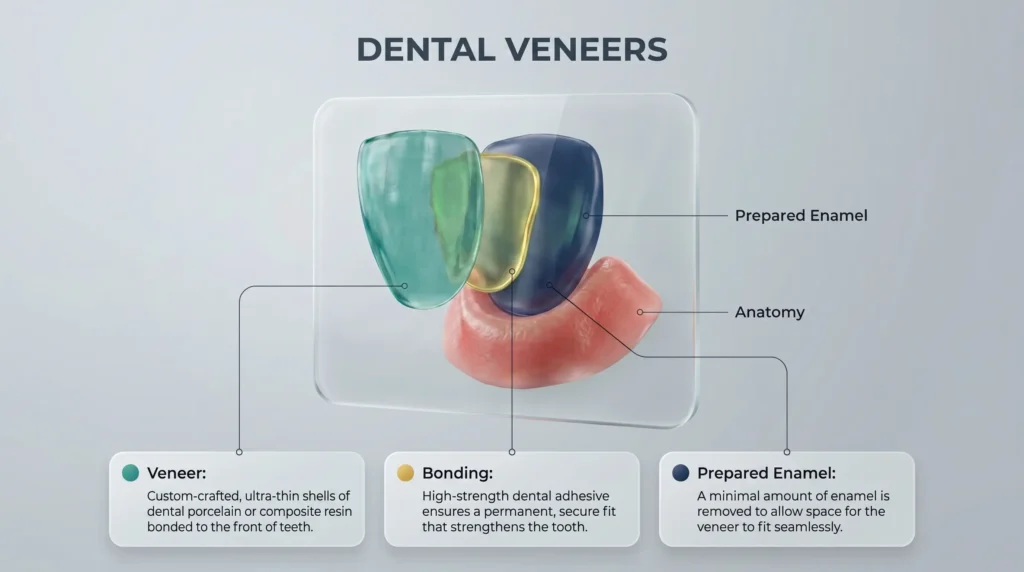
A veneer is approximately 0.3 to 0.7 mm thick. To accommodate it, a thin layer of enamel is removed from the front face of the tooth during preparation. This creates a surface the veneer can bond to permanently. The preparation is irreversible: once enamel has been removed, the tooth will always need either a veneer or a crown. This is the most important clinical fact about veneers that every patient should understand before proceeding.
What veneers can change is substantial. Colour: uniform bleaching-resistant whiteness that does not stain over time. Shape: teeth that are too small, too round, or worn can be given a new, designed silhouette. Chips and cracks: the ceramic covers and seals damage that compromises both aesthetics and structure. Small gaps: minor spacing can be closed without orthodontic treatment when the gap is within the range achievable by widening adjacent teeth. Length: teeth worn by grinding or erosion can be extended to a proportional length for the patient’s face.
What veneers cannot change
Veneers do not straighten significantly misaligned teeth. If teeth are substantially crooked, orthodontic treatment first produces better long-term results than a veneer placed on a poorly positioned tooth. Veneers also cannot fix issues with the bite or jaw relationship, and they are not placed on teeth with active decay or advanced periodontal disease. Any such issues are treated before veneers are considered at Andent Clinic, because a veneer placed on a compromised tooth will not last.
E.max, zirconia, and composite:
which material is right for your smile
The material you choose for your veneers directly determines how they look, how long they last, and how they interact with light. Here is the clinical comparison that helps you and the clinical team make the right choice for your specific case.
E.max Lithium Disilicate
E.max (Ivoclar Vivadent) is a glass-ceramic with a translucency profile that is the closest any artificial material comes to natural tooth enamel. Light passes through E.max in the same layered way it passes through enamel, which creates the depth and vitality that distinguishes a great smile from a flat, artificial-looking one. It is the material of choice for the anterior teeth that define the smile zone.
Zirconia Ceramic
Zirconia (zirconium dioxide) is the strongest ceramic material available for dental restorations. It has less translucency than E.max, which means it does not transmit light in the same way. For patients with dark underlying tooth structure, very dark staining from tetracycline antibiotics, or post-root canal treated teeth, zirconia provides superior masking capability that E.max cannot always achieve at the same thinness.
Composite Bonding
Composite bonding is not a veneer in the ceramic sense. It is a tooth-coloured resin applied and sculpted directly on the tooth surface by the clinician, without laboratory involvement. It requires little to no enamel removal in most cases. The advantage is reversibility: composite can be removed if needed. The limitations are longevity (5 to 7 years), staining over time, and the lack of the translucency and depth achievable with ceramic.
How E.max processes light
- Light enters the ceramic surface and scatters internally before reflecting back, creating optical depth rather than a flat white surface
- Different sections of the tooth appear lighter or darker depending on the direction of light, which is exactly how natural enamel behaves
- The incisal edge (the biting edge) of an E.max veneer can be milled with a translucent zone that mimics the natural incisal translucency of a healthy young tooth
- The result is that E.max veneers catch the light differently from different angles, making them appear alive rather than static
Why the in-house lab matters for shade accuracy
- The laboratory technician at Andent Clinic attends the shade selection appointment in person, under natural and clinical light, with the patient present
- Digital shade-matching photographs sent to external labs lose the subtle colour gradient information that the human eye registers in context
- When the veneers are tried in before final cementation, the technician is available on the same day to make any shade adjustments before permanent bonding
- This in-person iteration is impossible when the laboratory is in a different building or a different city from the clinic
How your smile is designed
before a single tooth is prepared
The most important part of a veneer treatment is the design phase that happens before any preparation. Understanding the treatment sequence explains why the in-house laboratory and the 5 to 6 day visit timeline are inseparable from the quality of the result.
Shade selection happens under natural light with the laboratory technician present. The patient and technician agree the shade before any preparation. Most veneer patients choose shades in the B1 to A2 range, which is noticeably whiter than natural teeth but still credible as a real smile. Extreme shades like BL1 (near pure white) are available but require careful discussion to ensure the result looks proportional to the patient’s face and skin tone.

Smile photographs and digital preview
Send photographs of your smile: front on smiling, front on relaxed, close up of teeth. The clinical team assesses your existing tooth shape, gum line symmetry, and colour. Digital treatment planning provides a preview of the approximate result before any commitment is made. This is not a binding design but it gives both patient and clinician a shared visual reference for the treatment goals.
Smile design consultation with the laboratory technician
The most important appointment of the entire treatment. The laboratory technician, the dentist, and the patient discuss the target shade under natural and clinical light. Wax-up models showing the proposed tooth shapes are reviewed. The number of veneers (typically 6, 8, or 10 depending on the smile width) is confirmed. This is the stage where patient expectations are aligned with what the materials and anatomy can achieve.
Lab technician present in person
Tooth preparation and temporary veneers
A thin layer of enamel is removed from the front surface of each tooth to be veneered. The amount removed is the minimum necessary to accommodate the ceramic: typically 0.3 to 0.5mm for E.max. Impressions or digital scans of the prepared teeth are sent to the laboratory immediately. Temporary veneers of the agreed shape and approximate shade are bonded to protect the prepared teeth and give the patient an immediate preview of the final shape. Most patients are surprised by how good the temporaries look.
Temporaries fitted same day as preparation
In-house fabrication: 48 hours
The veneers are milled from E.max or zirconia blocks in the CAD/CAM laboratory on the floor above the clinical areas. The technician can check the shade against the patient’s photographs and the selected reference. Because the lab is in-house, any adjustments identified during this phase can be communicated and implemented without courier delays. The patient spends these days exploring Tirana.
Laboratory is inside the clinic buildingTry-in and pre-bond review
Before permanent cementation, all veneers are placed on the teeth dry for a final review. Patient and clinician assess the shade, shape, margins, and bite together. If anything is not precisely right, the technician is available the same day to make adjustments. This is the stage where in-house production is most valuable: at an external lab clinic, this adjustment would require a return visit weeks later. Here it is resolved before the patient leaves for the evening.
Permanent bonding and final polish
Each veneer is bonded permanently using dental adhesive cement that sets under a curing light. The bond strength between well-prepared enamel and E.max ceramic is extremely high. Final adjustments to the bite are made, the margins are polished, and the patient leaves with their permanent veneers. Post-bonding photographs are taken in clinical and natural light. The transformation from the photographs taken on Day 1 is typically striking.
Permanent result same weekIdeal veneer candidates
and cases that need a different approach
Veneers are one of the most effective cosmetic dental treatments available, but they are not the solution for every aesthetic concern. Understanding who benefits most and what conditions require a different approach saves patients from treatments that do not address their actual problem.
Good candidates for veneers
- Patients with staining that does not respond to professional whitening, including fluorosis, tetracycline staining, and intrinsic discolouration from past trauma
- Teeth that are worn, chipped, cracked, or have eroded edges that compromise both the appearance and the structural integrity of the tooth
- Teeth that are too small (microdontia) or disproportionately narrow relative to the patient’s smile width
- Small gaps or mild spacing between front teeth where orthodontics would take 12 months and veneers can achieve a good result in a week
- Patients who have already had whitening and want a permanently white, non-staining result
- Patients preparing for a significant event such as a wedding who want a fixed, long-lasting smile improvement rather than a temporary solution
- Patients whose existing veneers are aged, stained, or chipped and need replacement with better materials
Cases requiring careful assessment
- Severe crowding or misalignment: veneers placed on badly crooked teeth do not look natural and are more prone to chipping at their margins. Orthodontics first, then veneers.
- Active bruxism: grinding habits generate bite forces that ceramic cannot withstand long-term without protection. An occlusal guard worn at night is essential and must be part of the treatment plan.
- Very short teeth from severe wear: if the tooth has insufficient height for the veneer to bond to, a crown may provide better retention and longevity.
- Active gum disease: this must be treated and stable before any aesthetic dental work. Healthy gum margins are essential for the aesthetic result to look correct.
- Patients with very high bite forces who grind specifically on the front teeth: the preparation and occlusal relationship needs specific planning.
Why the in-house laboratory
is not a marketing claim
Many dental clinics describe themselves as having laboratory facilities. At Andent Clinic, the laboratory is on the floor above the clinical areas. The dental technician who mills your veneers is the same person who attends your shade consultation. This is a specific clinical advantage, not a generic quality indicator.
For international patients visiting Tirana for one week, the location of the laboratory determines whether a same-week veneer result is clinically possible. An external laboratory receiving impressions by courier on Day 1 and returning veneers on Day 8 or 9 means the patient’s week is insufficient. An in-house laboratory that receives impressions on Day 1 and returns completed veneers on Day 3 makes the same-week result achievable without clinical compromise.
But the time advantage is only one dimension of what in-house means. The more important dimension is communication. When the laboratory technician attends the shade consultation in person, they observe the patient’s skin tone, the existing colour of adjacent teeth, and the quality of light in the room. They make the shade decision with the same information the eye processes, not from a digital photograph taken in different light conditions sent to a remote facility.
What happens when shade is slightly off
At a clinic using an external laboratory, a veneer that is marginally the wrong shade at the try-in appointment creates a decision: accept it, or wait weeks for a remake. At Andent Clinic, the laboratory technician reviews the try-in result and can adjust the shade the same day. Minor shading adjustments are made in-house before cementation. The patient does not leave with a result they are not satisfied with, and they do not wait weeks for a correction.
48-hour fabrication, not 2 to 3 weeks
Milled from E.max or zirconia blocks in-house. No courier time. Result ready within the same visit.
Technician at the shade appointment
The person who makes the veneer sees the patient in person. The colour decision is made with real-world visual information.
Same-day adjustments at try-in
Minor shade or shape changes at the try-in appointment are resolved before cementation. No remake waiting period.
Quality control on every veneer
The clinical team inspects each veneer under magnification before the bonding appointment. No compromised units are placed.
| Factor | External lab | Andent in-house |
|---|---|---|
| Fabrication time | 7 to 14 days | 48 hours |
| Same-week completion | ✕ | ✓ |
| Technician at shade consultation | ✕ | ✓ |
| Same-day shade adjustments | ✕ Weeks wait | ✓ Same day |
| Direct technician-patient communication | ✕ | ✓ |
| Trips needed for completion | Usually 2 | 1 visit |
Veneer savings for patients
across Europe
E.max veneers at Andent Clinic cost €300 per tooth. The comparison with home-country prices is substantial for patients from every major European market. Select your country to see the specific comparison and flight connections.
🇩🇪 Veneers für Patienten aus Deutschland
In Deutschland kostet ein einzelnes E.max Veneer in einer führenden kosmetischen Zahnarztpraxis in Berlin, München, Hamburg oder Frankfurt zwischen €800 und €1,400. Ein vollständiges Lächeln mit 8 Veneers kostet €6,400 bis €11,200. Die gleiche Behandlung mit E.max-Veneers, die im eigenen Labor der Andent Klinik in Tirana hergestellt werden, kostet €300 pro Zahn und €1,200 für 8 Veneers.
German cosmetic dental treatments are not covered by statutory health insurance (GKV). Supplementary dental insurance may partially cover some prosthetic work, but aesthetic veneers are specifically excluded from most German dental insurance products. The treatment is self-funded regardless of whether it is done in Germany or abroad.
German patients are consistently among the most satisfied at Andent Clinic because the price differential is so significant and the material quality (E.max from German and Swiss manufacturers) is identical to what German cosmetic dentists use. The German-speaking coordination team manages the full process in German.
- ✈️ Frankfurt to Tirana: 2h 20min, daily from €60 return (Lufthansa, Wizz Air)
- ✈️ Munich to Tirana: 2h 15min, 4 to 5x weekly from €65 return
- ✈️ Berlin to Tirana: 2h 30min, 3x weekly from €70 return
🇫🇷 Facettes dentaires pour les patients de France
En France, une facette en E.max dans un cabinet de dentisterie esthétique de premier plan à Paris, Lyon ou Bordeaux coûte entre €700 et €1,200 par dent. Un sourire complet avec 8 facettes représente entre €5,600 et €9,600. La même intervention avec des facettes E.max fabriquées dans le laboratoire interne de la Clinique Andent à Tirana coûte €300 par dent et €1,200 pour 8 facettes.
In France, cosmetic veneers are not reimbursed by social security. The aesthetic nature of the treatment places it firmly in the category of elective care that mutual insurance (mutuelle) does not cover. French patients fund veneer treatments entirely out-of-pocket regardless of the country of treatment.
The French-speaking coordinator at Andent Clinic handles all communication, from initial consultation through to the post-treatment documentation. Tirana is well-connected from Paris with multiple weekly direct flights.
- ✈️ Paris CDG to Tirana: 2h 30min, 4x weekly (Air France, Wizz Air) from €65 return
- ✈️ Paris Orly to Tirana: regular connections from €60 return
🇪🇸 Carillas dentales para pacientes de España
En España, una carilla de E.max en una clínica de odontología estética de primer nivel en Madrid, Barcelona o Valencia cuesta entre €500 y €1,000 por diente. Un smile makeover completo con 8 carillas cuesta entre €4,000 y €8,000. El mismo tratamiento con carillas E.max fabricadas en el laboratorio interno de la Clínica Andent en Tirana cuesta €300 por diente y €1,200 por 8 carillas.
Las carillas dentales estéticas no están cubiertas por la sanidad pública española ni por los seguros dentales privados estándar. Se trata de un tratamiento electivo de financiación íntegramente privada. El coordinador de habla hispana en la Clínica Andent gestiona toda la comunicación en español.
Desde España, los vuelos a Tirana son directos desde los principales aeropuertos y el ahorro en el tratamiento compensa ampliamente el coste del viaje.
- ✈️ Barcelona a Tirana: 2h 45min, opciones regulares desde €70 ida y vuelta
- ✈️ Madrid a Tirana: 3h 10min, Wizz Air y conexiones desde €75 ida y vuelta
🇮🇹 Faccette dentali per i pazienti dall’Italia
In Italia, una faccetta in E.max in uno studio di odontoiatria estetica di primo livello a Roma, Milano o Firenze costa tra €600 e €1,100 per dente. Un sorriso completo con 8 faccette costa da €4,800 a €8,800. Lo stesso trattamento con faccette E.max realizzate nel laboratorio interno della Clinica Andent di Tirana costa €300 per dente e €1,200 per 8 faccette.
For Italian patients, Tirana is uniquely accessible. The 1 hour 45 minute direct flight from Rome and the under-2-hour connection from Milan make Tirana the closest practical destination for dental tourism from Italy. The Italian-speaking coordinator manages all communication in Italian and clinical documentation is provided in Italian on request.
Many Italian patients combine the veneer treatment con a short exploration of Tirana, which has become an increasingly popular city break destination with good restaurants, a vibrant Blloku neighbourhood, and very low daily living costs compared to Italian cities.
- ✈️ Roma FCO a Tirana: 1h 45min, giornaliero da €55 andata e ritorno (ITA, Wizz Air)
- ✈️ Milano MXP a Tirana: 1h 50min, giornaliero da €55 andata e ritorno
- ✈️ Napoli, Bari, Bologna: connessioni via Roma, circa 3h totali
🇨🇭 Veneers for patients from Switzerland
Switzerland has the highest dental fees in Europe. A single E.max veneer at a leading Swiss cosmetic dental practice in Zurich, Geneva, or Basel costs between CHF 1,200 and CHF 2,000. Eight veneers cost CHF 9,600 to CHF 16,000. At Andent Clinic Tirana, the same E.max veneers cost €300 per tooth and €1,200 for 8 veneers. Swiss patients save more per veneer in absolute terms than patients from any other European country.
Swiss dental insurance covers basic dental care but not cosmetic treatments. Veneers are elective aesthetic procedures and are fully patient-funded in Switzerland. The coordination team covers German, French, and Italian, serving all three Swiss national language regions without any communication barrier.
The Zurich to Tirana flight takes 2 hours 10 minutes. Many Swiss patients travel for veneer treatment and spend several additional days in Tirana, where daily costs are a fraction of those in Swiss cities.
- ✈️ Zurich (ZRH) to Tirana: 2h 10min, 4 to 5x weekly from CHF 80 return (Swiss, Wizz Air)
- ✈️ Geneva (GVA) to Tirana: connections available via Zurich or other hubs
🇦🇱 Veneers për pacientët nga Shqipëria dhe diaspora
Andent Clinic is based in central Tirana and provides the same E.max and zirconia veneer quality available at European cosmetic dental centres, at Albanian market prices. The clinic serves both local Albanian patients and the Albanian diaspora from Germany, Italy, Switzerland, Greece, and beyond who return for treatment during visits home.
For patients from Kosovo, North Macedonia, and the Western Balkans, Tirana is accessible by road in 3 to 4 hours and by a short connecting flight from most regional capitals. The full clinical team is Albanian-speaking and the smile design process is conducted with the same attention and laboratory infrastructure as for international patients.
Albanian patients also benefit from the same written guarantee on ceramic integrity and bonding that is provided to international patients at no additional cost.
- 🚗 Pristina, Kosovo: approximately 3 hours by road
- 🚗 Skopje, North Macedonia: approximately 3.5 hours by road
- ✈️ Athens to Tirana: daily direct, 1h 10min
What patients describe when
they talk about their veneers
These accounts are selected not because they are the most effusive, but because they describe what the process was actually like and what specific concern brought each patient to consider dental veneers in Albania. All are 5-star patient stories with specific savings noted, including examples such as €1,200 in Tirana compared with a €9,200 German quote.
“Ich hatte seit meiner Kindheit gelb-braune Fluorose-Flecken auf meinen vorderen acht Zähnen. Bleaching hat sie sogar sichtbarer gemacht. Mein Zahnarzt in Deutschland hatte mir €9.200 für 8 E.max Veneers angeboten. In Tirana kostete dasselbe Material €1.200. Der Labortechniker kam am ersten Tag persönlich dazu und wir haben 40 Minuten lang die genaue Farbe ausgewählt. Ich gewöhne mich immer noch daran, mein Spiegelbild zu sehen und nicht zusammenzuzucken.”
“Vingt ans de bruxisme ont réduit mes incisives de plusieurs millimètres. Le devis à Lyon était de €8.800 pour dix facettes. À Tirana, c’était €1.500 avec exactement le même matériau E.max d’Ivoclar Vivadent. La coordinatrice parlait français. Mes dents ont retrouvé leur longueur d’origine et je porte maintenant un protège-dents la nuit.”
“Avevo un diastema centrale e i bordi delle incisive irregolari. Il dentista a Milano mi aveva consigliato prima l’ortodonzia, 18 mesi, e poi le faccette. A Tirana il dentista ha valutato che il diastema era abbastanza piccolo da essere chiuso con le faccette stesse. Sei faccette E.max, €900, cinque giorni. Sono tornata a Milano con un sorriso completamente diverso.”
“Tenía tinción gris por antibióticos de la infancia. Me dijeron que necesitaría coronas, no carillas, por el color tan oscuro. El dentista en Tirana explicó que las carillas de circonio podían enmascarar el color sin necesidad de preparación tan agresiva como una corona. El resultado fue exactamente lo que necesitaba. El coordinador hablaba español desde el primer mensaje.”
Sandra is a corporate lawyer in Zurich who had been in high-visibility client-facing work for 20 years. She describes her teeth as always having bothered her since her teens: slightly grey underlying colour, uneven lengths, and chips on both upper lateral incisors from a cycling accident at university. Her Zurich dentist had quoted CHF 15,000 for 10 E.max veneers and a wait of six weeks for the laboratory work.
“I am Swiss-German and I did my research the way I do everything: thoroughly. I contacted four dental tourism clinics across Albania, Hungary, and Turkey. Andent was the only one that explained that the laboratory was inside the clinic building and what that meant for the timeline and shade accuracy. That told me something about how they think about their work.”
The shade consultation on Day 1 was the part Sandra was most nervous about. She had very specific requirements: not movie-star white, but a bright, natural-looking shade that would not read as obviously false to other professionals. The laboratory technician brought a Vita shade guide and they spent time under both clinical and natural window light comparing shades against her skin tone and the colour of her eyes. They agreed on shade A1, which is noticeably white but retains the warmth that prevents veneers from looking synthetic.
The temporaries fitted on Day 1 were already in the agreed shape and close to the target shade. “I went back to the place where I stayed and smiled at myself in the bathroom mirror for about ten minutes. I was wearing temporaries and I already looked like a different person. The permanent veneers three days later were better than the temporaries.”
Sandra’s Zurich dentist reviewed her at the six-month check-up. The margins were perfectly sealed and the shade was holding exactly as placed. Total cost in Tirana including 10 E.max veneers, a 6-night stay in coordinated accommodation, and both flights: approximately CHF 2,600. The Zurich quote had been CHF 15,000 for the veneers alone.
To compare your own case with real patient outcomes, view the smile gallery or send your photos, X-rays, or treatment plan through the free consultation form.
What patients worry about
before getting veneers abroad
These are the concerns patients most frequently raise before committing to veneer treatment in Tirana. They deserve direct answers, not reassurance without substance.
Why dental veneers in Albania make sense for European patients who have priced the alternative
A smile makeover with 8 E.max veneers at a reputable cosmetic dental clinic in Zurich, Munich, Paris, or Milan costs between €5,600 and €14,000 depending on the city and the clinic. The same treatment at Andent Clinic Tirana, using the same Ivoclar Vivadent E.max material in an in-house laboratory with a 48-hour fabrication standard, costs €2,400 for 8 E.max veneers. Including flights and a 6-night stay in coordinated accommodation, the total expenditure for most European patients is typically between €3,000 and €3,600.
This is not a compromise. The material is the same. The fabrication technology is the same: CAD/CAM milling of E.max blocks, comparable to the laboratory process used in Western European dental facilities. What differs is the cost structure: clinical and laboratory costs are substantially lower in Albania, and premises in central Tirana cost a fraction of equivalent locations in Zurich, Munich, Paris, or Milan. This is why dental tourism in Albania can offer significant savings without changing the ceramic material.
Why in-house fabrication is not just about speed
The argument for an in-house laboratory is often framed as a time advantage. That is real: 48 hours versus 2 to 3 weeks means international patients can complete veneer treatment in a single trip. But the more significant advantage is quality control over shade accuracy. The laboratory technician who attends the shade consultation, makes the veneer from the agreed specifications, and reviews the result before cementation is a different clinical asset from a remote technician working from a digital file.
The most common complaint patients report after cosmetic veneer treatment anywhere in the world is that the shade was slightly different from what they expected. In many cases this reflects a communication failure between what the patient expressed to the dentist, what the dentist communicated to the laboratory, and what the technician interpreted from that communication. At Andent Clinic, the technician is the person the patient speaks to directly about the shade. That chain of communication is shorter, clearer, and more accurate.
To find out whether veneers are the right option for your smile, send your photos, X-rays, or treatment plan through the free consultation form. You can also compare real patient outcomes in the smile gallery.
What patients ask before
choosing veneers in Albania
Ready to design your smile?
Send smile photographs and get a personalised veneer plan with exact pricing in 24 hours. The clinical team assesses the shade, shape, and number of veneers that suit your face. Free, no obligation.
Mon to Sat · 9:00 to 18:00 CET
WhatsApp 7 days
🇩🇪 🇫🇷 🇪🇸 🇮🇹 🇬🇧 spoken
What patients say about
their treatments at Andent
Ready to design your smile?
Receive a personalised veneer plan within 24 hours.
Send your smile photos and receive a personalised veneer plan with exact pricing within 24 hours. Shade is selected with you in person. The laboratory is inside the clinic. Written guarantee included.