

Top Things to Do in Tirana During Your Dental Tourism Trip
Discover the top things to do in Tirana during your dental tourism trip, including Skanderbeg Square, Blloku, the Dajti Express cable car, museums, street art, cafés, restaurants, and easy day trips from the city. This guide helps international patients combine dental treatment at Andent Clinic with a comfortable, recovery-friendly travel experience in Albania’s vibrant capital.
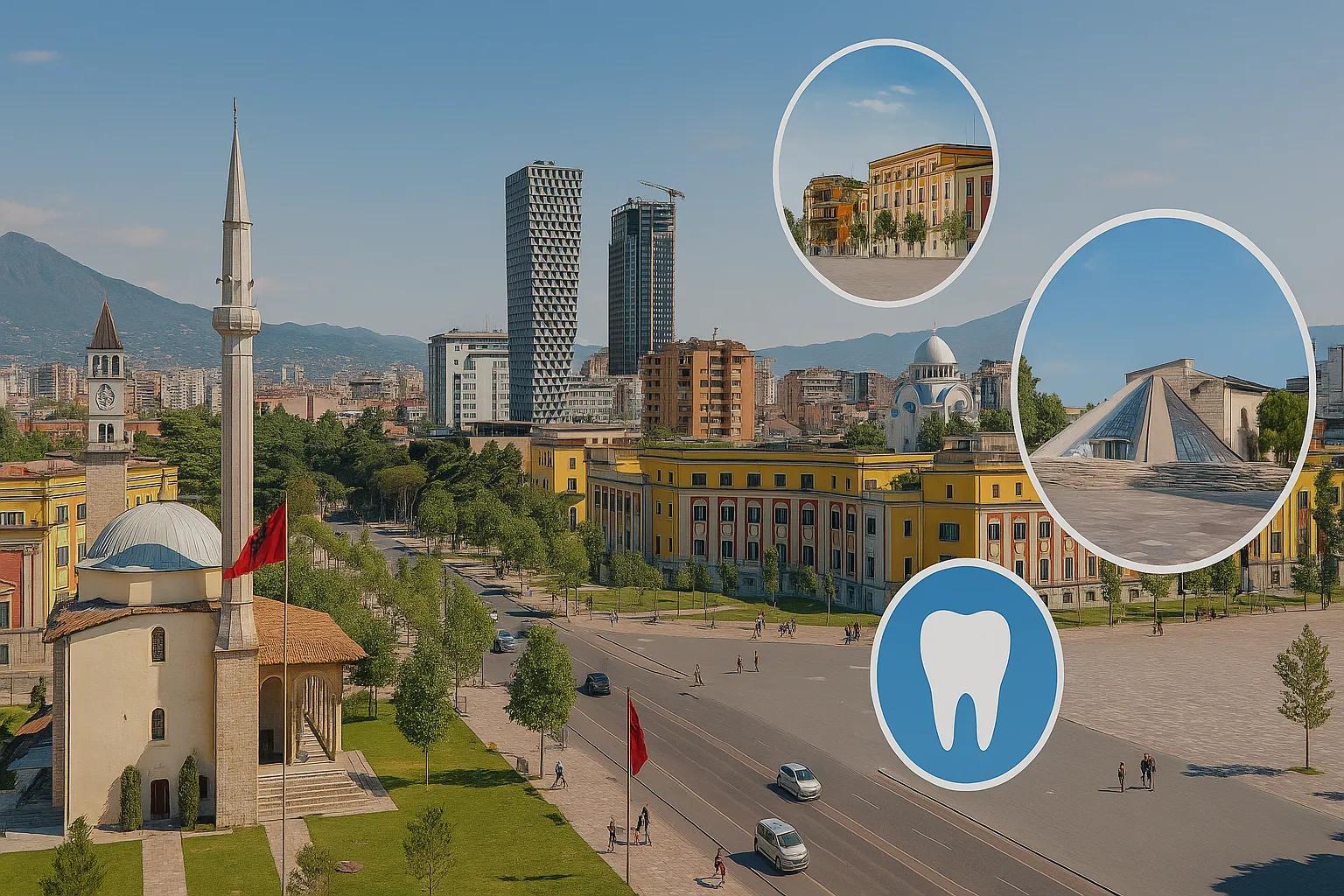
When visiting for dental tourism Albania, most patients stay in Tirana, the country’s vibrant capital. Between treatments at the best dental clinic in Albania, there is plenty to enjoy.
Start with Skanderbeg Square, the city’s heart, surrounded by museums and cultural landmarks. The National History Museum offers insights into Albania’s past, while the Et’hem Bey Mosque showcases stunning Ottoman architecture.
Art lovers can visit the National Gallery or explore the colorful street art scattered across the city. Tirana is also famous for its cafés, perfect for relaxing during recovery from dental implants Albania or cosmetic dentistry Albania.
For a taste of modern Tirana, head to Blloku, a lively district filled with restaurants, bars, and boutiques. It is a great place to enjoy local cuisine or unwind after a day of appointments.
Nature is never far away. Take the Dajti Express cable car up the mountain for panoramic views of the city. Many patients find this a relaxing excursion while undergoing orthodontics Albania or a smile makeover Albania.
Tirana combines tradition, culture, and modern energy, making your dental trip both rewarding and enjoyable.
Tirana Is Worth Discovering. Here Is Where to Start.
Most patients who travel to Andent Clinic in Tirana for dental treatment arrive with no particular expectations about the city itself. They come for the dental care, the savings, and the convenience. What many of them discover is that Tirana is a genuinely interesting and enjoyable place to spend several days, and that the time between appointments can be used to explore a capital city that is rarely visited by tourists from Western Europe but richly rewards those who do.
Albania as a country has one of the most dramatic modern histories in Europe. Isolated behind the world’s strictest communist regime from 1944 to 1991, it emerged from decades of enforced isolation into a rapid, chaotic, and ultimately successful process of modernisation. Tirana today reflects all of that history: Ottoman mosques alongside communist-era bunkers, colourful painted apartment blocks covering the grey architecture of the Hoxha era, a new generation of cafes and restaurants opening on streets that forty years ago were effectively off limits to the world.
The city is compact, walkable, and safe. For dental patients who need to rest after a procedure, it offers the convenience of everything being within easy reach. For those who feel well enough to explore, there is enough to fill several days without ever leaving the city centre.
Skanderbeg Square: The Heart of the City
Every visitor to Tirana eventually finds themselves at Skanderbeg Square, the vast central plaza that anchors the city. Named after Albania’s national hero, the medieval warrior-king Gjergj Kastrioti Skanderbeg, the square is surrounded by the most historically significant buildings in the capital.
The National History Museum occupies the northern side of the square and is one of the largest and most comprehensive museums in the Western Balkans. Its mosaic facade, depicting Albanian history from antiquity to modern times, is itself one of the most striking works of public art in the city. The museum’s collection covers Albanian archaeology, Byzantine and Ottoman history, the resistance movements of the Second World War, and the period of communist dictatorship with surprising frankness.
The Et’hem Bey Mosque at the corner of the square is a jewel of Ottoman architecture, built in the late eighteenth century and famous for its unusually fine interior frescoes depicting trees, waterfalls, and bridges, imagery rarely seen in Islamic religious art. It survived the communist period intact, unlike most religious buildings in Albania, and was reopened to worshippers in 1991 in a gathering that symbolised the end of the regime’s 45-year ban on religious practice.
Blloku: Where the City Comes Alive
The neighbourhood known as Blloku was, during the communist period, a sealed residential compound reserved exclusively for the political elite. Ordinary Albanians were prohibited from entering under threat of severe punishment. Since 1991, it has transformed into the most vibrant social district in the capital, a dense network of cafes, restaurants, boutiques, cocktail bars, and gelato stands that hums with activity from morning to well past midnight.
For dental patients who have just had a procedure and need soft food options, Blloku delivers. The restaurant scene has diversified enormously over the past decade, and it is possible to find excellent soups, pastas, smoothie bowls, and other soft-food options at places ranging from casual cafes to more formal restaurants. Italian cuisine is particularly well represented, reflecting the close cultural ties between Albania and Italy.
The coffee culture in Blloku is also worth experiencing. Albanians take their coffee extremely seriously, and the espresso available in even modest-looking cafes in this part of the city is exceptional. Spending an afternoon working from a Blloku cafe with a coffee and a soft pastry is a perfectly pleasant way to pass recovery time.
The Dajti Express Cable Car
A twenty-minute drive from the city centre brings you to the base station of the Dajti Express, a gondola cable car that ascends Mount Dajti, the forested peak that rises above the eastern edge of Tirana. The ride itself takes fifteen minutes and provides increasingly spectacular views over the city as it climbs. At the top, at an altitude of around 1,600 metres, the air is cooler and the view is panoramic. On a clear day you can see all the way to the Adriatic coast.
The summit has a hotel, a restaurant, and a small amusement park that is popular with local families at weekends. For dental patients at the recovery stage of their treatment, the gentle walk along the mountain tracks near the top station is ideal: enough movement to be refreshing without the physical demands of serious hiking.
The Dajti Express is easy to combine with an afternoon outing. Patients typically take a taxi from central Tirana to the cable car base, ride to the top, spend two to three hours exploring, have lunch at the summit restaurant, and return to the city in the early evening.
The National Gallery of Arts and Tirana’s Street Art Scene
The National Gallery of Arts houses the most significant collection of Albanian fine art, spanning from the Ottoman period through the social realist paintings of the communist era to contemporary work. The realist paintings from the Hoxha period are particularly striking as historical documents: large-scale canvases depicting Albanian workers, soldiers, and revolutionary moments in a style directly comparable to Soviet socialist realism. They are genuinely interesting as art objects and as windows into a totalitarian aesthetic programme.
Street art has also become one of Tirana’s most distinctive characteristics. The urban renewal programmes of the early 2000s encouraged artists to paint the facades of communist-era apartment blocks, and the result is a city peppered with large-scale murals ranging from abstract colour explosions to politically charged imagery. The area around the Pyramid of Tirana, a former monument to Enver Hoxha now repurposed as a youth cultural space, and the streets of the Komuna e Parisit neighbourhood are particularly rich in murals.
Day Trips from Tirana
Patients with more than five or six days in Albania often take advantage of the country’s remarkable proximity of landscapes and historical sites to Tirana. Kruja, a beautifully preserved hilltop town with a castle, a bazaar, and museums dedicated to Skanderbeg, is only 40 minutes north of the capital by road.
Berat, a UNESCO World Heritage town known as the city of a thousand windows for its distinctive Ottoman architecture, is two hours south. Butrint, a UNESCO-listed ancient city at the southern tip of the country near Saranda, combines Greek, Roman, Byzantine, and Venetian ruins in an extraordinary archaeological park. And the Albanian Riviera along the Ionian coast offers some of the most beautiful and least-developed coastline in the Mediterranean, with waters to match the best of the Greek islands.
Frequently Asked Questions About Visiting Tirana
Is Tirana safe to walk around as a tourist?
Yes. Tirana is a safe city with a low rate of violent crime. Standard urban precautions apply, but visitors from Western European cities typically find Tirana considerably less stressful than their home capitals.
What currency is used in Albania?
The Albanian currency is the lek (ALL). Euros are widely accepted in tourist areas and at hotels, and many restaurants will accept them. Andent invoices international patients in euros.
Is English spoken in Tirana?
English is increasingly common in Tirana, particularly among younger people and in the hospitality industry. Italian is very widely spoken. The Andent team speaks English, Italian, and Albanian fluently.
What is the best time of year to visit Tirana?
Spring and autumn are the most pleasant seasons, with warm temperatures and lower humidity than summer. Tirana can be very hot in July and August, though air conditioning is standard in hotels and restaurants.
Can I use my phone as normal in Albania?
Albania is not in the EU, so EU roaming rules do not apply. UK patients also have no automatic roaming agreement. Check with your mobile provider about roaming charges or consider purchasing a local SIM on arrival.
Newsletter
Get Dental Tips in Your Inbox
One email per month. Expert guides, patient stories, and exclusive offers — no spam.
Get Started
Free Treatment Plan in 24 Hours
Send us your X-rays or photos. Our specialists will reply with a full, personalised quote — no obligation.
Latest Articles
-
 October 4, 2026
Why Are Dental Implants So Expensive? (And How to Pay 70% Less)
Learn what drives dental implant costs in the UK, why the NHS rarely covers implants, and how treatment in Tirana can reduce the total… Read more
-
 October 4, 2026
How Long Are NHS Dentist Waiting Lists? (And the Fastest Way to Skip the Line)
See how long NHS dentist waiting lists can be, why delays happen, how dental problems can progress, and what alternatives UK patients may consider. Read more
-
 October 3, 2026
How to Find Affordable Dental Care Without Insurance
Explore practical ways to find affordable dental care without insurance, from dental schools and payment plans to lower-cost treatment at Andent Clinic in Tirana. Read more
Ready to Start?
Your New Smile is One
Consultation Away
Send us your X-rays or dental photos and receive a personalised treatment plan with clear pricing within 24 hours — completely free of charge. No obligation. No pressure. Just clarity.