

Replace missing teeth without surgery. Fixed, permanent, and fast.
Get fixed, natural looking dental bridges at Andent Clinic in Albania. A dental bridge restores your smile by anchoring custom crowns to neighboring teeth without dental implant surgery or bone grafts. Thanks to our in house laboratory in Tirana, your bridge is milled in 48 hours for a permanent, comfortable fit before you fly home.
Three teeth treated.
One seamless result.
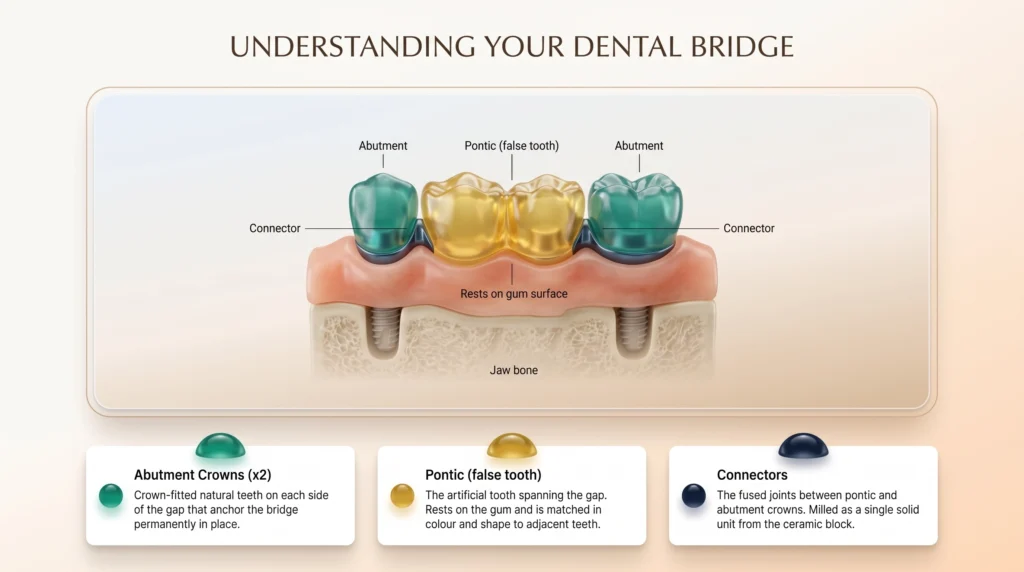
A dental bridge is a fixed prosthetic device that spans the gap left by a missing tooth. Understanding how it is built helps explain both its strengths and the clinical situations where it works best.
Every bridge has three structural components. The two outer units are called abutments. These are the natural teeth on either side of the gap, which are prepared by removing a controlled amount of enamel and dentine to receive dental crowns. Those crowns anchor the bridge in place. The middle unit is called the pontic. This is the artificial tooth that sits over the gap and recreates the missing tooth in every visible way — colour, size, form, and bite function.
The key distinction between a bridge and a removable partial denture is permanence. A bridge is cemented in place and cannot be taken out. It functions like your natural teeth. You do not remove it to clean it. You eat with it, speak with it, and smile with it exactly as you would with natural teeth. No clasps, no adhesive, no overnight soaking.
What the bridge cannot do is replace the missing tooth root below the gum line. Because the pontic rests on the gum surface without anchoring into the bone, the bone underneath gradually reduces in volume over time through a process called resorption. This happens slowly and does not affect how the bridge functions or looks in the short to medium term, but it is a clinically meaningful difference from a dental implant for patients planning for twenty or more years.
Bridge or implant:
when each one is the right answer
This is the question every patient with a missing tooth faces. There is no universally correct answer. The right choice depends on the clinical condition of the adjacent teeth, not on cost alone or on a general preference for one treatment over the other.
Four types of dental bridge.
One right solution per case.
The type of bridge used depends on how many teeth are missing, where in the mouth the gap is located, and the condition of the available supporting teeth.

Traditional 3-Unit Bridge
The most common bridge design worldwide. One pontic (false tooth) suspended between two abutment crowns. Replaces a single missing tooth. Both abutment teeth are prepared and receive full crowns as part of the bridge structure. The result is a solid three-piece unit cemented permanently in place. Ideal when one tooth is missing and both neighbours are present and healthy enough to serve as abutments.
Most common · Single missing tooth
Extended Bridge (4 to 6 Units)
When two or three adjacent teeth are missing, the bridge spans a wider gap using multiple pontics supported by abutment teeth at each end. The structural engineering of a longer bridge places greater load on the abutment teeth, which must have sufficient root support and bone levels to carry the additional load safely. Bone levels and abutment root health are assessed from X-rays before the treatment plan is confirmed.
Two or three consecutive missing teeth
Cantilever Bridge
A cantilever bridge is anchored on only one side rather than two. It is used when there is only one adjacent tooth available — typically at the end of the dental arch. The biomechanics of a cantilever design place higher stress on the single abutment tooth, so this option is selected carefully and primarily for teeth that do not bear heavy bite forces. It is more commonly indicated in the front of the mouth than the back.
Single abutment available · Front teeth
Maryland (Resin-Bonded) Bridge
A Maryland bridge uses metal or crown wings bonded to the backs of the adjacent teeth, with minimal or no preparation of the tooth surfaces. It is the most conservative option when the adjacent teeth are completely healthy and the patient strongly wants to avoid preparation. The trade-off is lower retentive strength compared with a traditional bridge, making it most suitable for front teeth where bite forces are lower. It is not recommended for molars.
Minimal tooth preparation · Front teeth onlyWhich ceramic material:
is right for your bridge?
Bridge fabrication uses the same ceramic materials as individual dental crowns, but the clinical selection follows slightly different logic because a bridge spans a gap and carries higher structural loads than a single-tooth crown. Here is how the three options perform in a dental bridge context.
Prepared Day 1.
Cemented Day 5.
The in-house dental laboratory at Andent Clinic mills every bridge unit overnight using CAD/CAM technology. The connector geometry between pontic and abutment crowns is engineered to clinical specifications, not estimated. This is the factor that makes a 4 to 5 day complete bridge treatment possible for international patients.
The cleaning technique
that determines longevity
This is the section most clinics skip when fitting dental bridges, and it is the information that matters most to how long the restoration lasts. Cleaning a dental bridge is not the same as cleaning natural teeth. Standard brushing alone is not sufficient, and patients who do not understand why find out the hard way when secondary decay develops on the abutment teeth under the bridge margin a few years after cementation.
The critical area to clean is the gap between the underside of the pontic and the gum surface beneath it. This gap traps food debris and plaque. If plaque accumulates in this area daily over months and years, it leads to gum inflammation around the abutment teeth and eventually to decay at the crown margins. This is the single most common reason dental bridges fail before their expected lifespan.
The good news is that cleaning this area correctly takes less than two minutes a day once you develop the habit. Before leaving Tirana, every Andent Clinic patient who receives a bridge is given a practical demonstration of the correct technique using superfloss. The instructions are also included in the written clinical report you take home after your dental tourism treatment in Albania.
The warning that protects your investment
A dentist cannot clean under your bridge during a standard six-month check-up if plaque has hardened into tartar in that area. Ask your home dentist to specifically check the subpontic space at every visit and to use a probe to verify the gum health around each abutment tooth. Early detection of beginning decay at a crown margin can often be managed with a restoration rather than a full bridge replacement.

Superfloss
Specifically designed for bridges. Has a stiffened threader section that you pass beneath the pontic, a spongy section that cleans under the bridge, and a standard floss section for the contact points. Requires a 10-second technique once per day per bridge unit.
First recommendation for all bridge patients
Water Flosser, Oral Irrigator
A pulsed water jet cleans beneath the pontic and around the crown margins without requiring manual thread manipulation. Preferred by many patients for ease of use, particularly for longer bridges with two or more pontics. Brands like Waterpik have specific bridge settings.
Excellent alternative, especially for longer bridges
Interdental Brushes
Small cylindrical brushes sized to fit the gap between tooth and gum. Useful for cleaning the gum line around the abutment crowns but cannot reach all areas under the pontic. Best used in combination with superfloss or water flosser rather than as a standalone bridge cleaning tool.
Useful supplement to superfloss routine
Standard Toothbrush
Essential for cleaning the outer surfaces of the abutment crowns and the visible surface of the pontic. Use a soft-bristle brush at a 45-degree angle to the gum line. Cannot access the subpontic space, so it must be combined with one of the dental bridge cleaning methods above.
Necessary but not sufficient on its ownHow long do dental bridges last
and what drives the difference?
Average bridge survival by condition
Clinical data consistently shows that patient behaviour accounts for a larger portion of bridge longevity than material choice. The hygiene factor and bruxism management each individually have a bigger impact on survival time than upgrading from PFM to crown.
The four factors that determine your bridge’s lifespan
-

Daily subpontic cleaning
Using superfloss or a water flosser under the pontic every day prevents plaque accumulation that leads to abutment decay. This single habit has more impact on bridge lifespan than any other factor within the patient’s control.
-

Night guard if you grind your teeth
Bruxism generates forces three to five times greater than normal chewing. These forces act on the connector between pontic and abutment crown, which is the most mechanically stressed part of the bridge. A night guard reduces these forces to manageable levels and significantly extends the lifespan of any bridge material.
-

Annual abutment monitoring
Your home dentist should specifically examine the gum health around each abutment tooth and probe for any marginal gap at every annual check-up. Early intervention when a margin begins to open can save the bridge. Waiting until symptoms appear is usually too late to prevent full replacement.
-
Initial abutment tooth health
The health of the abutment teeth at the time of bridge placement is a major determinant of long-term success. Bridges placed on abutments with compromised root support or active gum disease have significantly shorter average lifespans. This is why Andent Clinic assesses abutment bone levels on X-ray before treatment is confirmed.
Bridge costs: Albania vs UK, Germany and beyond
All Andent Clinic prices include tooth preparation, provisional bridge, in-house CAD/CAM fabrication in 48 hours, permanent cementation and a written clinical report in English. There are no additional laboratory or consultation fees.
Everything you need to
know before deciding
Ready for your free quote?
Send an X-ray or photo of the area that needs a bridge. We will confirm the treatment plan, material recommendation, and exact price within 24 hours.
Mon to Sat · 9:00 to 18:00 (CET)
WhatsApp available 7 days
What patients say about
bridges at Andent Clinic
Other treatments available
alongside your bridge